In focus: Vogue — October 31, 1917
TL;DR — The Vogue issue dated October 31, 1917 is an autumn number from the magazine’s illustrated-cover era, published in the first wartime autumn after the United States entered the First World War. Its date is a good occasion to tell a lesser-known part of Vogue’s story: the Vogue Pattern business, the magazine’s long trade in cut-paper dress patterns that let readers make couture-influenced clothes at home — a sideline that became newly important in the thrift culture of 1917–18. This piece covers the pattern business, the illustrated cover, and the wartime autumn the issue belongs to.
By The Day Press · Published July 2026
Vogue’s other business: dress patterns
Vogue is remembered as a magazine, but from the turn of the century it was also in the business of selling dress patterns — the printed paper templates a home dressmaker used to cut and sew a garment. Vogue began offering patterns to readers in 1899, and the operation grew steadily enough that in 1914 it was organised into the Vogue Pattern Company, a distinct business alongside the magazine.
This mattered more than it sounds. In an era when a large share of American women’s clothing was still made at home or by a local dressmaker, a pattern from Vogue let a woman of modest means approximate the silhouettes the magazine’s Paris coverage put in front of her. The pattern business extended Vogue’s influence far below the wealthy readership Nast’s advertising targeted — the magazine set the styles, and the patterns carried them into ordinary households.
Thrift, sewing, and the wartime autumn of 1917
The pattern business became newly relevant in the war. By the autumn of 1917 the United States had been at war since April, and a culture of visible thrift had taken hold: the Food Administration under Herbert Hoover promoted ‘meatless’ and ‘wheatless’ days, and ‘economy’ became a patriotic virtue. Vogue folded this into its fashion advice, promoting simpler dress, the remaking of existing clothes, and home sewing.
An autumn issue in this climate did two things at once: it still delivered the season’s forecast — the new silhouettes, the Paris news — while increasingly framing dress as something a resourceful, patriotic woman could make and manage herself. Home sewing, and the Vogue patterns that served it, sat naturally inside that message.
The illustrated cover
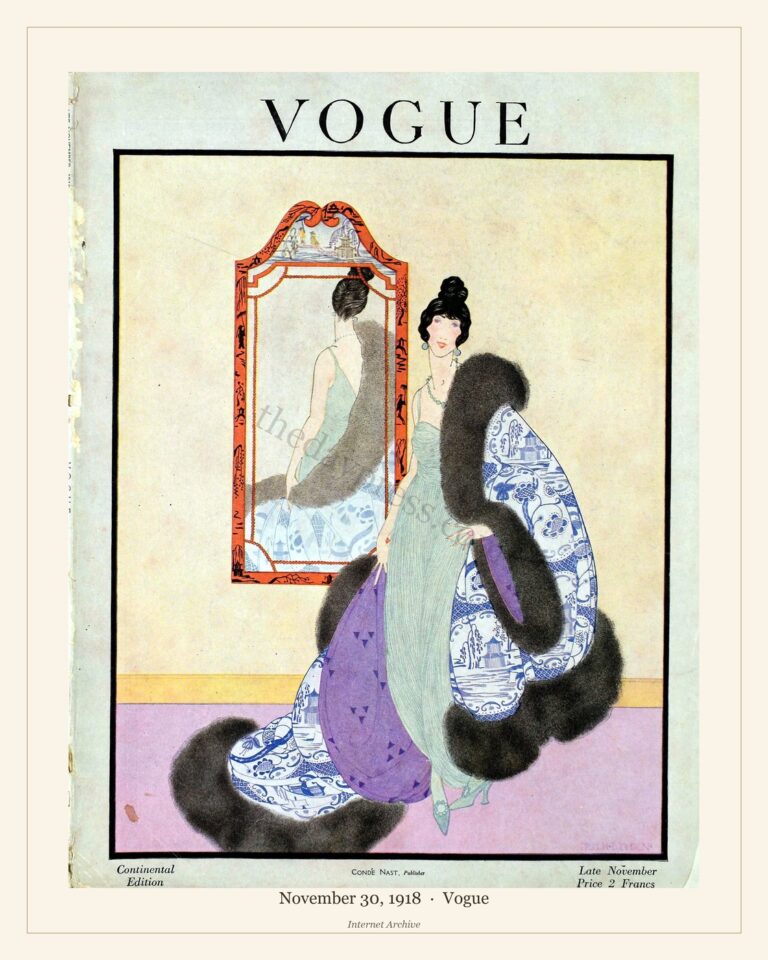
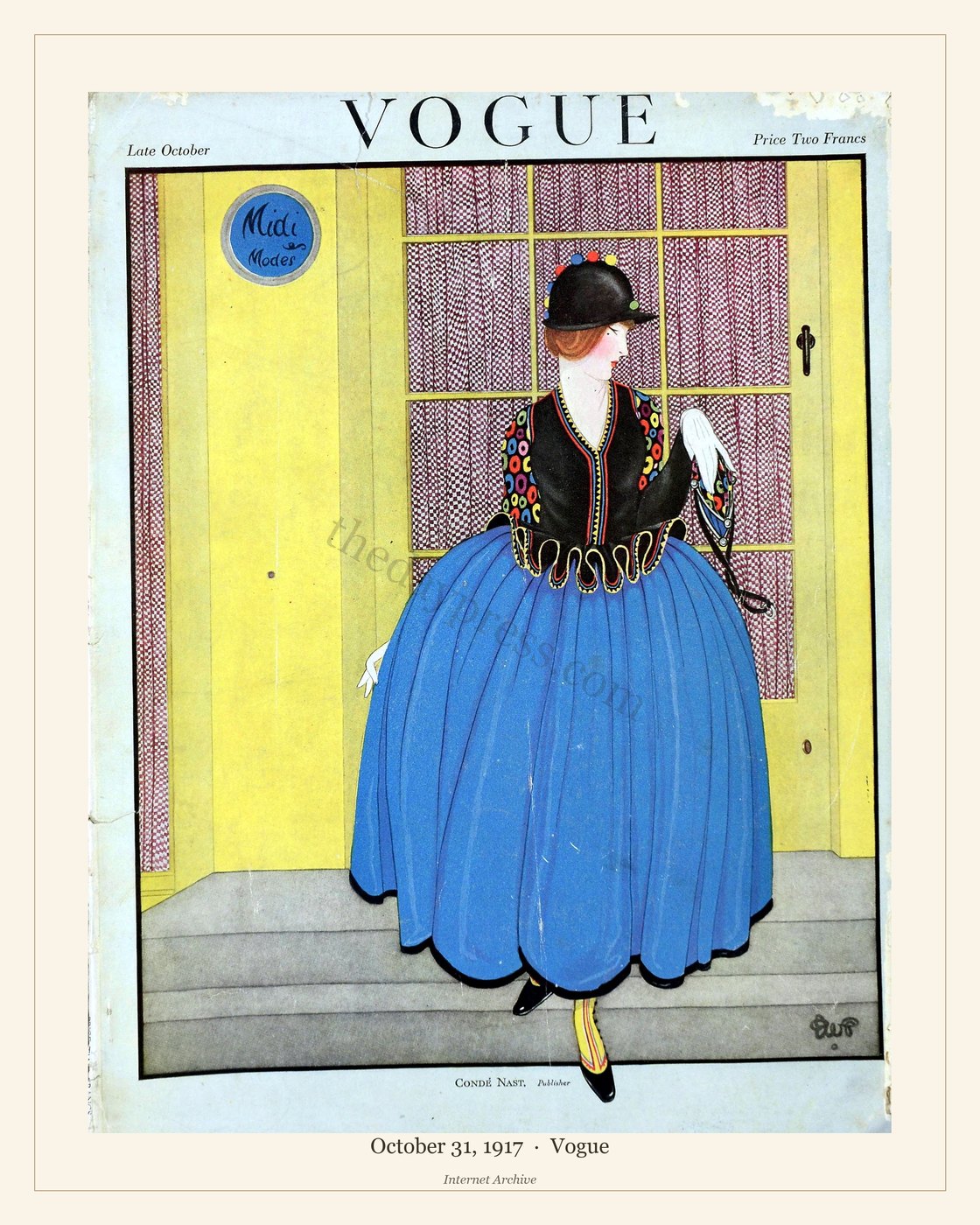
The cover of this issue, like every Vogue cover between 1909 and 1932, was a commissioned illustration rather than a photograph. Vogue’s autumn covers tended toward richer, cooler palettes suited to the season, the work of the magazine’s regular cover artists — Helen Dryden, George Wolfe Plank, and their colleagues — whose decorative, poster-like designs are what make these covers read as graphic art rather than fashion reportage.
The point worth holding onto is that the cover was an idea of autumn, not a record of a specific garment. That is why it survives as an image when the season’s actual clothes — and the patterns cut to make them — are long gone.
Why the drawn covers endure
Vogue’s illustrated covers form a closed set, roughly 1909 to 1931, ended by the arrival of the photographic cover in 1932. They are collected today as a coherent chapter in design history — and, dated to a specific issue, each one anchors the magazine’s grand seasonal machine to a single real moment, in this case the first wartime autumn of the United States.
The Vogue covers in our archive are drawn from this illustrated era, each dated to the real issue it appeared on. Browse the Vogue covers →
Frequently asked questions
Did Vogue sell dress patterns?
Yes. Vogue offered dress patterns to readers from 1899, and organised the business as the Vogue Pattern Company in 1914. The patterns let home dressmakers approximate the styles the magazine promoted.
Why did home sewing matter in 1917?
Wartime thrift made it patriotic. With the Food Administration promoting economy, Vogue encouraged simpler dress, remaking clothes, and home sewing — which its pattern business directly served.
Is the cover a drawing?
Yes. Every Vogue cover between 1909 and 1932 was an illustration; the first photographic cover came in 1932.
Who drew Vogue’s covers then?
Chiefly Helen Dryden and George Wolfe Plank in the 1910s, with Georges Lepape and Eduardo Benito bringing Art Deco from around 1920.
Further reading
- Browse Vogue covers
- Browse magazine cover art
- Norberto Angeletti and Alberto Oliva, In Vogue: The Illustrated History of the World’s Most Famous Fashion Magazine (Rizzoli, 2006).
- Nancy Bryant and Kiki Smith, on the history of commercial dress patterns; see also the Vogue Patterns company histories.
The Day Press curates, restores, and reformats public-domain American printed images from 1885 to 1928 for archival-quality home printing. Browse the archive · Browse by theme, month, decade.