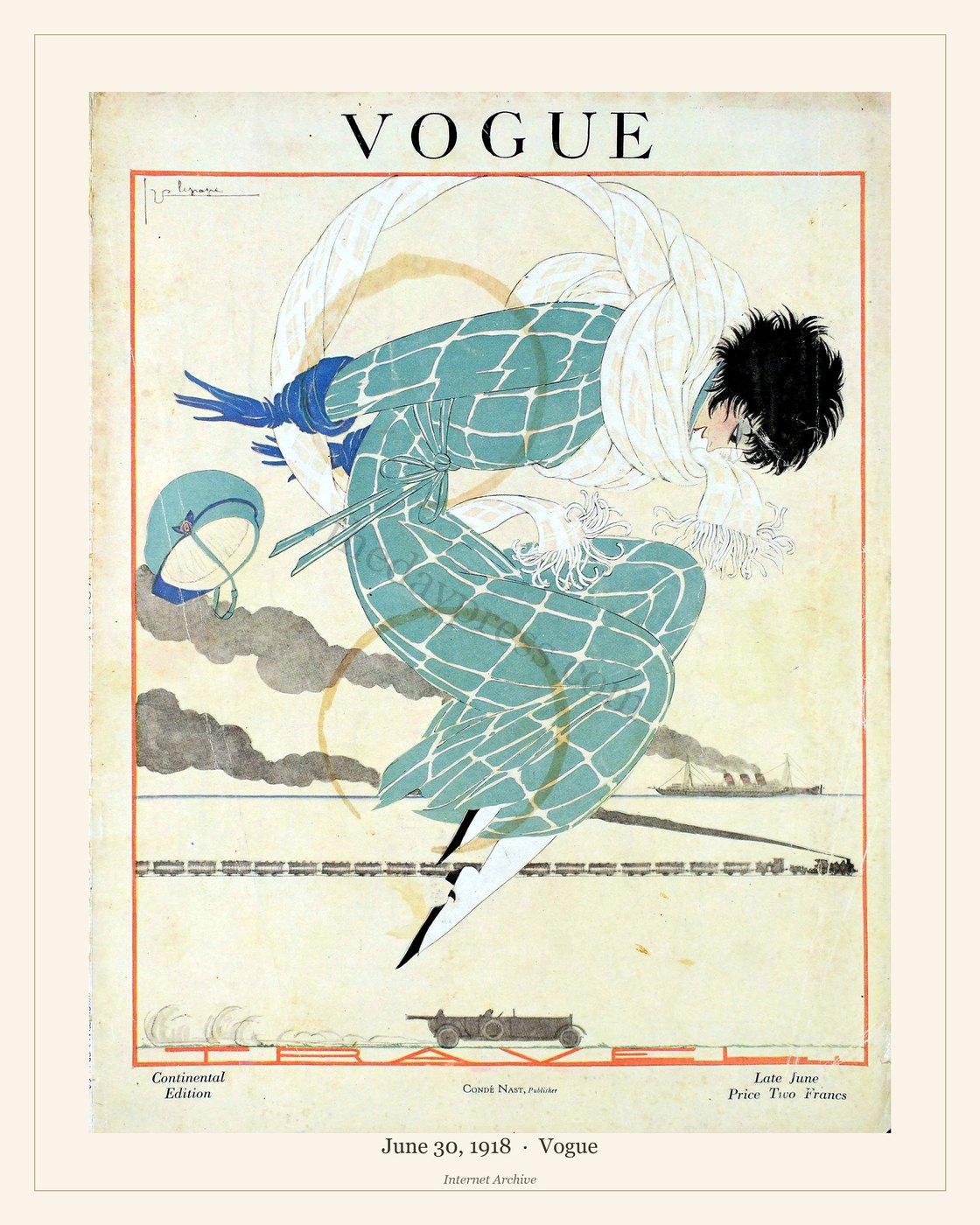
In focus: Vogue — June 30, 1918
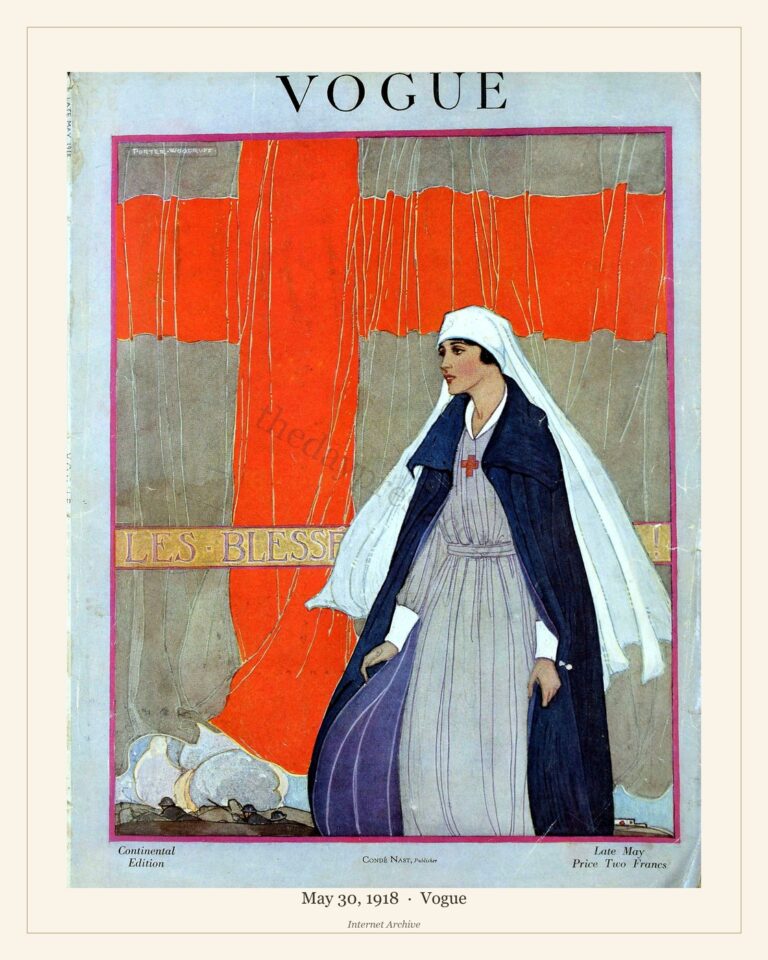
TL;DR — The Vogue issue dated June 30, 1918 is a midsummer number from the final summer of the First World War. Its date is a good occasion to profile a second of Vogue’s defining cover artists: George Wolfe Plank, the self-taught Pennsylvanian whose jewelled, fantastical covers — peacocks, crescent moons, elaborate borders — gave the magazine some of its most memorable images across the 1910s and 1920s. This piece profiles Plank, sets him beside his peers, and places the issue in the war’s last summer.
By The Day Press · Published August 2026
George Wolfe Plank, Vogue cover artist
George Wolfe Plank (1883–1965) was born in Reading, Pennsylvania, and, like Helen Dryden, was largely self-taught. He began contributing to Vogue in the early 1910s and produced covers for the magazine for more than two decades. Where Dryden’s line was fluid and Lepape’s would be sleek and modern, Plank’s sensibility was ornamental and fantastical: peacocks, crescent moons, night skies, gardens, and figures set within elaborate decorative borders.
His covers drew on the decorative traditions of the age — Aubrey Beardsley’s black-and-white intricacy, the jewelled orientalism then fashionable, the poster art of the 1890s — and turned them to the fashion cover. They are among the most immediately recognisable of all Vogue covers, and they show how much latitude Condé Nast gave his artists: a Plank cover is a small designed world, not a dress illustration.
An artist’s life between two countries
Plank eventually settled in England, where he moved in literary and artistic circles — he was connected to the Bloomsbury world and designed book jackets, including work associated with Virginia Woolf’s Hogarth Press. His career is a reminder that the magazine cover artists of this era were serious designers who moved fluidly between commercial illustration, book design, and fine art.
That breadth is part of why the illustrated Vogue cover reached the quality it did. Nast recruited artists of real ambition and gave them room; the covers repaid him with images that outlived the issues they fronted.
The war’s last summer
The issue is dated to midsummer 1918, the final summer of the war. The Allied counter-offensives that would force the Armistice — the Hundred Days — were just beginning. Vogue kept to its seasonal calendar throughout, its summer numbers covering resort and warm-weather dress even as the magazine’s editorial pages carried the war’s themes of thrift and simpler dress.
The cover, as always, is best read as an idea of the season rather than a record of a garment — in Plank’s case, quite literally a decorative fantasy — which is exactly why it survives as an image a century later.
The Beardsley inheritance
One source of Plank’s ornate, fantastical manner is worth naming: Aubrey Beardsley, the English illustrator whose black-and-white line work for the 1890s magazine The Yellow Book and for Oscar Wilde’s Salome scandalised and enthralled a generation. Beardsley’s intricate, decadent decoration — all sinuous line and daring negative space — became a template for a whole school of decorative illustration on both sides of the Atlantic.
Through artists like Plank, that Beardsley inheritance reached the American fashion cover, softened and coloured for a wider audience. It is a reminder that the Vogue cover was not a sealed commercial world but a point where several currents of turn-of-the-century art — the poster, Art Nouveau, Beardsley’s decadence — flowed together.
A dated cover from the illustrated era
Vogue’s drawn covers form a finite body of work, roughly 1909 to 1931, ended by the photographic cover of 1932. Dated to the summer of 1918, this one belongs to the active years of Plank, Dryden, and their colleagues — the small group whose hands gave Vogue its enduring look.
The Vogue covers in our archive come from the illustrated era of Plank and his peers, each dated to the real issue it appeared on. Browse the Vogue covers →
Frequently asked questions
Who was George Wolfe Plank?
A self-taught American artist (1883–1965) from Pennsylvania who drew Vogue covers for more than two decades, known for jewelled, fantastical designs — peacocks, moons, elaborate borders. He later settled in England and did book-design work.
What influenced his style?
The decorative traditions of the age: Aubrey Beardsley’s intricacy, fashionable orientalism, and 1890s poster art, all turned to the fashion cover.
Who were Vogue’s other cover artists then?
Helen Dryden, Georges Lepape, and Eduardo Benito, among others, alongside Plank.
Is the cover a drawing?
Yes — every Vogue cover from 1909 to 1932 was illustrated, not photographed.
Further reading
- Browse Vogue covers
- Browse magazine cover art
- William Packer, The Art of Vogue Covers 1909–1940 (Bonanza Books, 1980).
- Norberto Angeletti and Alberto Oliva, In Vogue: The Illustrated History of the World’s Most Famous Fashion Magazine (Rizzoli, 2006).
The Day Press curates, restores, and reformats public-domain American printed images from 1885 to 1928 for archival-quality home printing. Browse the archive · Browse by theme, month, decade.