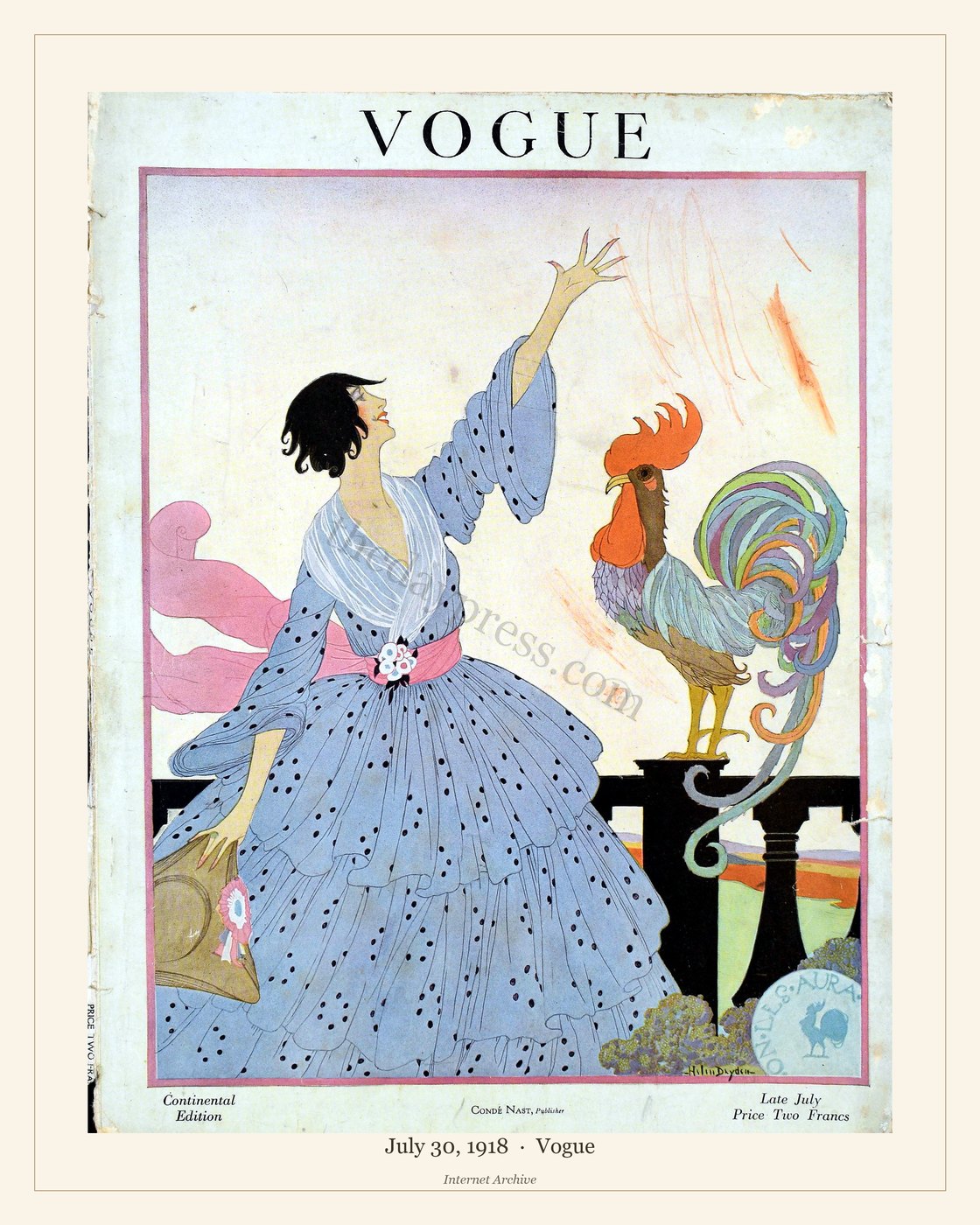
In focus: Vogue — July 30, 1918
TL;DR — The Vogue issue dated July 30, 1918 is a ‘hot weather’ number from the last summer of the First World War. Its date is a good occasion to tell how Vogue became international — and how, paradoxically, the war itself created British Vogue. When Atlantic shipping made it impossible to send the American magazine reliably to Britain, Condé Nast launched a locally-printed British edition in 1916, the first step toward the global Vogue of today. This piece explains that expansion, the illustrated cover, and the summer of 1918.
By The Day Press · Published August 2026
How the war created British Vogue
One of the more unexpected consequences of the First World War was the internationalisation of Vogue. Before the war, copies of the American magazine were shipped to a small but valuable readership in Britain. When wartime shipping restrictions and the danger of the Atlantic crossing made that supply unreliable, Condé Nast made a decisive move: rather than lose the British audience, he launched a separate, locally-produced British edition of Vogue in 1916.
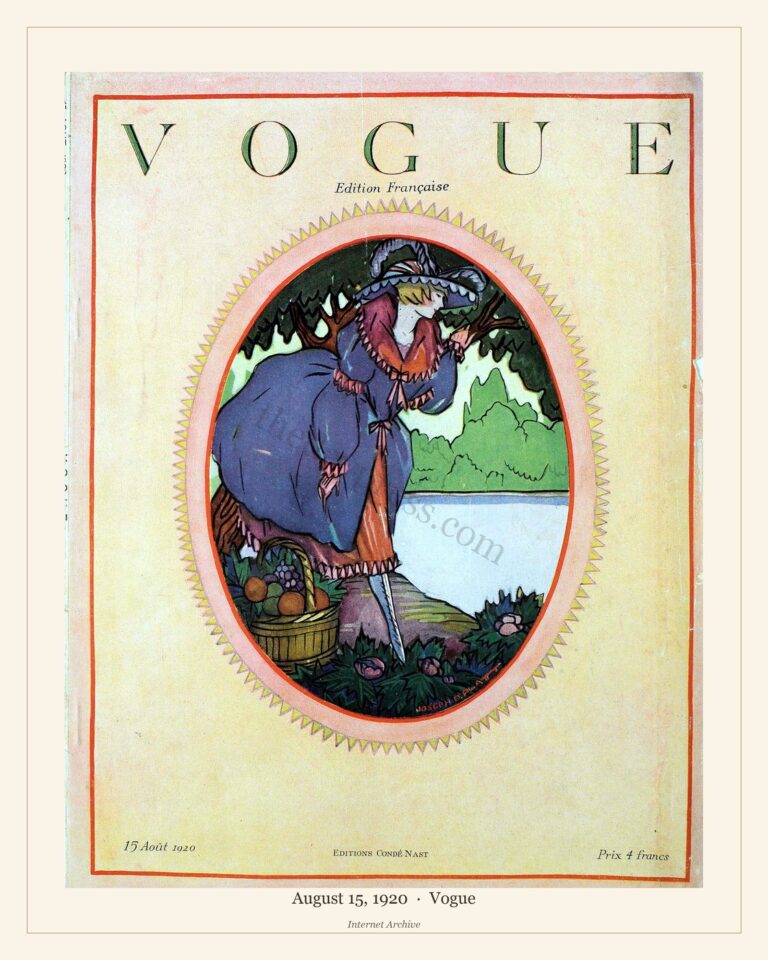
It was the first foreign edition of the magazine, and it established the model — a shared identity and standards, adapted and printed for a local market — that would eventually make Vogue a global institution. A French edition followed in 1920. What began as a wartime workaround became the template for the international Vogue that exists today.
One magazine, several editions
The multi-edition structure was more than a distribution fix; it was a statement about what Vogue was. Nast’s ‘class publishing’ aimed at a specific kind of reader — affluent, fashion-conscious, cosmopolitan — and that reader existed in London and Paris as surely as in New York. Producing local editions let Vogue reach her wherever she was while keeping the brand’s coherence.
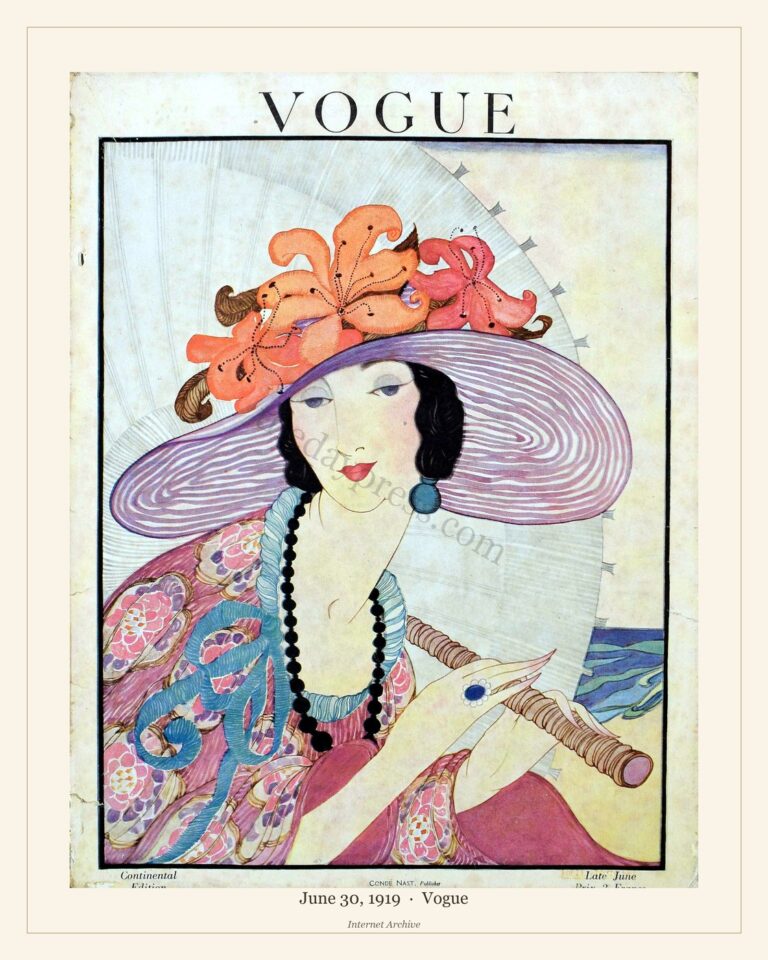
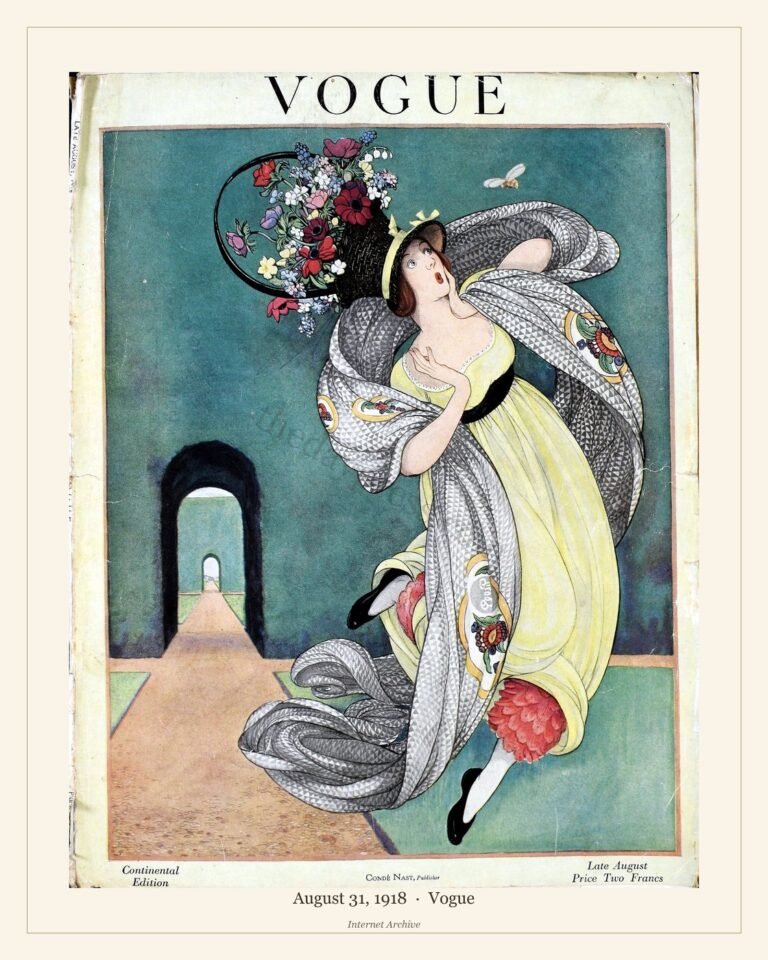
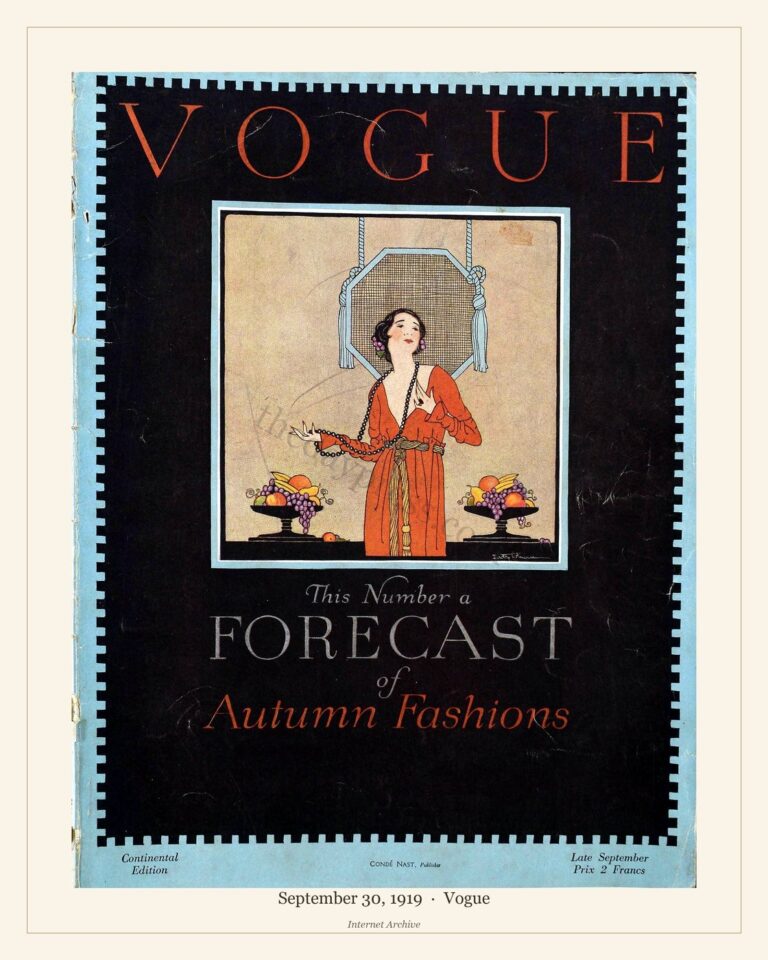
The covers were part of that coherence. The illustrated Vogue cover — drawn, stylised, aspirational — was a shared visual language across editions, even as each drew on its own artists and adapted to its market. The look this archive’s covers belong to was, by 1918, becoming an international one.
The last summer of the war
The issue is dated to late July 1918, as the Allied Hundred Days Offensive — the campaign that would end the war that November — was beginning. Vogue’s hot-weather numbers covered resort and summer dress, and the cover, like every Vogue cover from 1909 to 1932, was a commissioned illustration rather than a photograph.
That the magazine was expanding internationally in the middle of the war says something about the confidence and reach of Nast’s enterprise, and about fashion’s refusal to stop even at the conflict’s height.
The Condé Nast empire
British Vogue was one piece of a larger structure. Condé Nast built the first true magazine empire of the modern kind: alongside Vogue he relaunched Vanity Fair in 1913 as a smart magazine of arts and letters, owned House & Garden, and would later add other titles, each aimed at a specific slice of the affluent, cultivated readership his ‘class publishing’ strategy targeted.
The empire mattered to the covers. Nast’s titles shared a stable of artists — Benito, Lepape, and others moved between Vogue and Vanity Fair — and a common commitment to design quality, which concentrated the best commercial illustration of the age in a single company’s pages. The internationalisation that began with British Vogue in 1916 was the outward expansion of that empire.
A dated cover from the illustrated era
Vogue’s drawn covers form a finite set, roughly 1909 to 1931, ended by the photographic cover of 1932. Dated to the summer of 1918, this one comes from the moment Vogue was becoming the international magazine it remains — a shift the war itself set in motion.
The Vogue covers in our archive are drawn from this illustrated era, each dated to the real issue it appeared on. Browse the Vogue covers →
Frequently asked questions
When did British Vogue start?
In 1916. Condé Nast launched a locally-printed British edition when wartime Atlantic shipping made it impractical to send the American magazine to Britain. A French edition followed in 1920.
Why did the war lead to foreign editions?
Shipping restrictions and the danger of the Atlantic crossing threatened Vogue’s overseas readership, so Nast chose to produce editions locally rather than lose those readers.
Were the covers the same across editions?
The illustrated cover was a shared visual language, though each edition drew on its own artists and adapted to its market.
Is the cover a drawing?
Yes — every Vogue cover from 1909 to 1932 was illustrated, not photographed.
Further reading
- Browse Vogue covers
- Browse magazine cover art
- Caroline Seebohm, The Man Who Was Vogue: The Life and Times of Condé Nast (Viking, 1982).
- Norberto Angeletti and Alberto Oliva, In Vogue: The Illustrated History of the World’s Most Famous Fashion Magazine (Rizzoli, 2006).
The Day Press curates, restores, and reformats public-domain American printed images from 1885 to 1928 for archival-quality home printing. Browse the archive · Browse by theme, month, decade.