In focus: Vogue — June 30, 1919
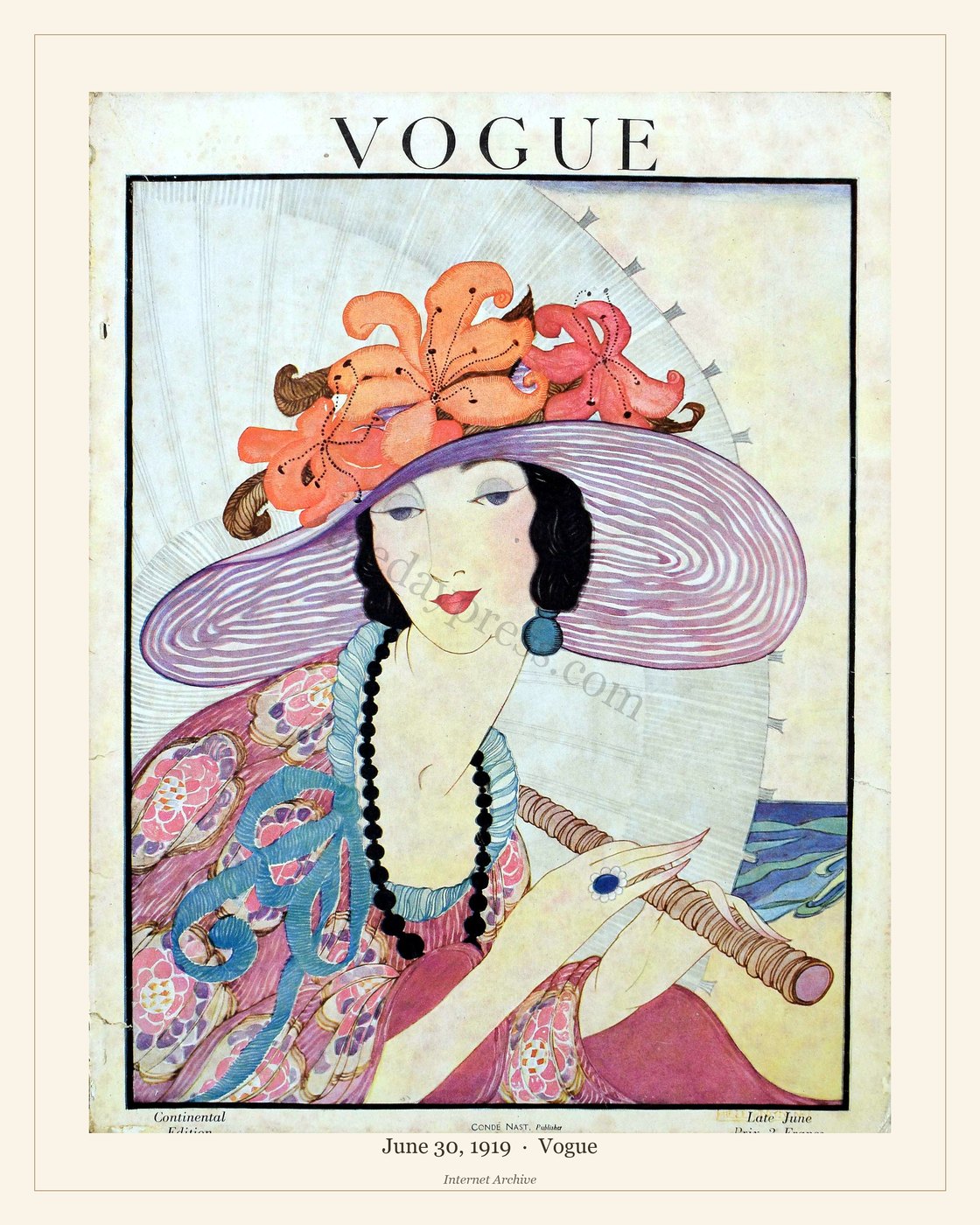
TL;DR — The Vogue issue dated June 30, 1919 is a midsummer number published two days after the Treaty of Versailles formally ended the First World War on June 28. Its date is a good occasion to profile the artist who, more than any other, carried the Paris avant-garde onto Vogue’s covers: Georges Lepape, who made his name illustrating the couturier Paul Poiret and brought the colour of the Ballets Russes to the American newsstand. This piece profiles Lepape, traces the Poiret–Ballets Russes–Vogue line, and places the issue in the first summer of peace.
By The Day Press · Published September 2026
Georges Lepape, from Poiret to Vogue
Georges Lepape (1887–1971) was a French artist trained in the Paris studios who came to fashion illustration at a decisive moment. In 1911 he produced Les Choses de Paul Poiret, an album of pochoir prints for the couturier Paul Poiret, whose bold, high-waisted, ‘oriental’ designs were then remaking fashion. The album is a landmark of modern fashion illustration — flat, brilliant colour, stylised figures, a decorative modernity that broke completely from the literal fashion plate.
Lepape brought that sensibility to Vogue, for which he drew covers over many years. His work — alongside that of Helen Dryden, George Wolfe Plank, and later Eduardo Benito — is central to why the illustrated Vogue cover reads as modern art. He also worked for Vanity Fair and other Condé Nast titles, one of the artists who tied the American magazines to the Paris avant-garde.
The Poiret–Ballets Russes–Vogue line
Lepape’s career traces a direct line from the Paris avant-garde to the Vogue cover. Paul Poiret had absorbed the colour revolution of Serge Diaghilev’s Ballets Russes — whose designer Léon Bakst had stunned Paris from 1909 with saturated, exotic colour — and channelled it into fashion. Lepape illustrated Poiret, then carried the same visual language into magazine covers.
This is the pipeline by which the most advanced European design of the 1910s reached ordinary American readers: from the Ballets Russes stage, to Poiret’s salon, to Lepape’s illustrations, to the cover of Vogue on a newsstand in New York. A Vogue cover of this period is the far end of that line — which is exactly why it carries real art-historical weight.
The first summer of peace
The issue is dated to June 30, 1919, two days after the Treaty of Versailles was signed on June 28, formally ending the war. It belongs to the first full peacetime summer, a season of renewed extravagance after four years of constraint; fashion, like society, was exhaling. Vogue’s summer numbers covered resort and warm-weather dress for a readership firmly back in peacetime.
The cover, as always, is an idea of the season rendered in the magazine’s graphic house style rather than a record of a garment — the reason it survives as an image a century on.
A dated cover from the illustrated era
Vogue’s drawn covers form a finite body of work, roughly 1909 to 1931, ended by the photographic cover of 1932. Dated to the first summer of peace, this one belongs to the years when Lepape and his peers made Vogue a gallery of the Paris avant-garde.
The Vogue covers in our archive come from the illustrated era of Lepape and his peers, each dated to the real issue it appeared on. Browse the Vogue covers →
Frequently asked questions
Who was Georges Lepape?
A French artist (1887–1971) who illustrated the couturier Paul Poiret’s 1911 album Les Choses de Paul Poiret and went on to draw many Vogue covers, bringing the flat, brilliant colour of the Paris avant-garde to the magazine.
How did the Ballets Russes influence Vogue?
Through a chain: the Ballets Russes’ colour revolution shaped Poiret’s fashion; Lepape illustrated Poiret and then Vogue, carrying that visual language onto the magazine’s covers.
When was this issue published relative to the war’s end?
Two days after the Treaty of Versailles was signed on June 28, 1919 — the first summer of the peace.
Is the cover a drawing?
Yes — every Vogue cover from 1909 to 1932 was illustrated, not photographed.
Further reading
- Browse Vogue covers
- Browse magazine cover art
- Nancy J. Troy, Couture Culture: A Study in Modern Art and Fashion (MIT Press, 2003).
- William Packer, The Art of Vogue Covers 1909–1940 (Bonanza Books, 1980).
The Day Press curates, restores, and reformats public-domain American printed images from 1885 to 1928 for archival-quality home printing. Browse the archive · Browse by theme, month, decade.