In focus: Vogue — October 31, 1919
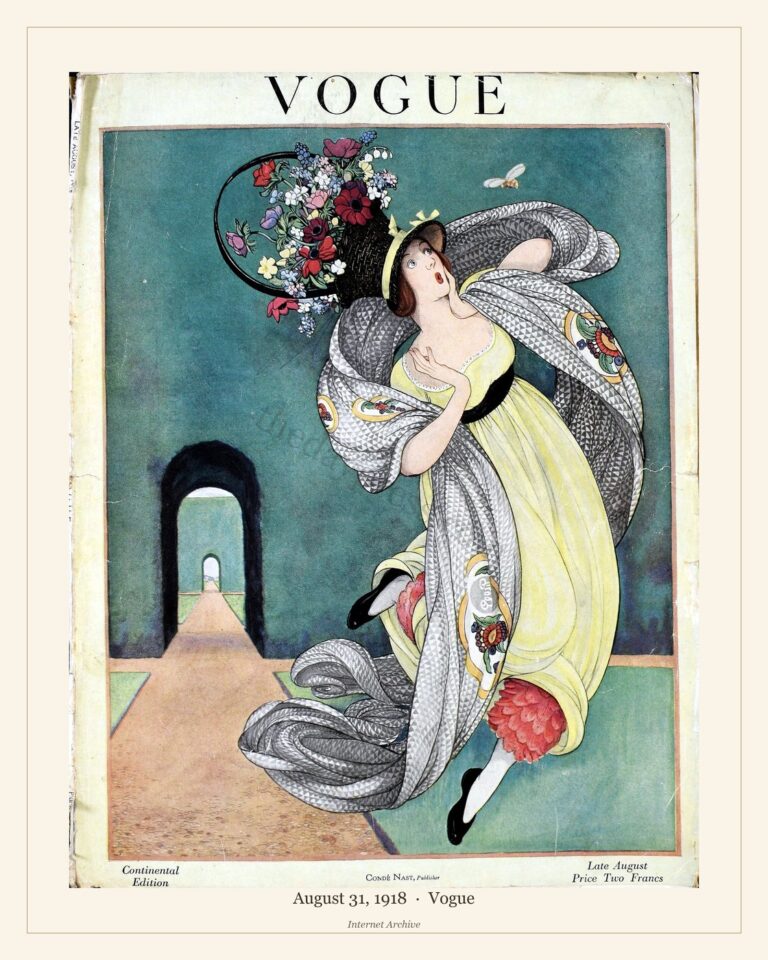
TL;DR — The Vogue issue dated October 31, 1919 is an autumn number from the first post-war year, on the very edge of the decade that would make Vogue synonymous with Art Deco. Its date is a good occasion to profile the artist who came to embody that style on the cover: Eduardo Garcia Benito, the Spanish painter whose severe, elegant geometry — learned in the Paris of Modigliani and the Cubists — defined the look of 1920s Vogue. This piece profiles Benito and the arrival of Art Deco on the cover, and places the issue at the turn into the 1920s.
By The Day Press · Published October 2026
Eduardo Benito and the modern Paris
Eduardo Garcia Benito (1891–1981) was a Spanish artist who came to Paris on a scholarship and absorbed the city’s avant-garde at its height — the world of Amedeo Modigliani, of Cubism, of the elongated, simplified figure. When he turned to fashion illustration and, from around 1920, to Vogue and Vanity Fair covers, he brought that modernist severity with him.
Benito’s covers are the essence of what people mean by ‘Art Deco Vogue’: flat planes of colour, elongated and stylised figures, strong geometry, an air of cool sophistication. Where the 1910s covers were decorative or fantastical, Benito’s were architectural. He, with Georges Lepape, gave 1920s Vogue its defining modern face.
The arrival of Art Deco on the cover
The style Benito worked in would only be named ‘Art Deco’ decades later, after the 1925 Paris Exposition Internationale des Arts Décoratifs that came to symbolise it. But its elements — geometry, streamlining, flat colour, a machine-age elegance — were arriving on Vogue’s covers right at the turn from the 1910s to the 1920s, the moment this autumn 1919 issue belongs to.
It is a useful reminder that a magazine cover can be a leading edge of design history, not a follower. The Deco sensibility reached a mass American audience through covers like these, issue by dated issue, before it had a name.
The illustrated cover and the turn of the decade
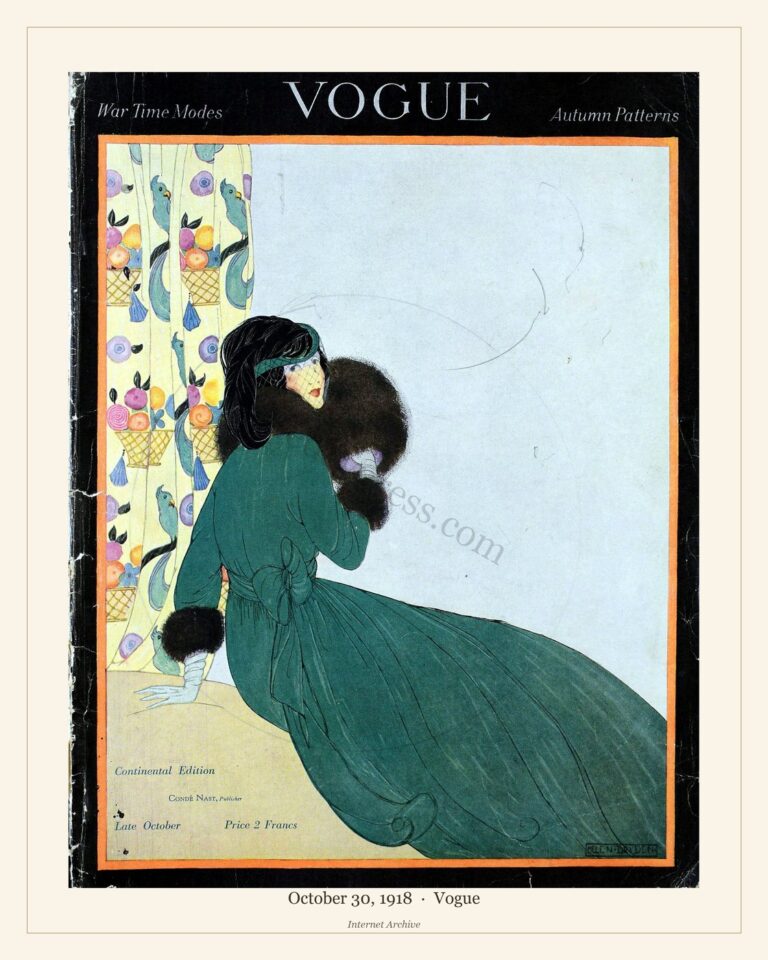
This issue closed the first post-war year. Its cover, like every Vogue cover from 1909 to 1932, was a commissioned illustration; an autumn 1919 cover sits exactly where the decorative 1910s style was giving way to the geometric 1920s one that Benito would come to define.
Vanity Fair and the sister magazines
Benito’s Art Deco covers appeared not only on Vogue but on its sister magazine, Vanity Fair, which Condé Nast had relaunched in 1913 under the editor Frank Crowninshield as a smart journal of arts, letters, theatre, and modern life. The two magazines shared artists, production standards, and a self-consciously modern sensibility.
This sister-magazine structure concentrated the finest commercial illustration of the 1920s — Benito, Lepape, and their peers — inside a single company, and let a coherent Art Deco visual language develop across Nast’s titles at once. A Vogue cover of this period is best understood as one face of that larger modern-design project, not an isolated commission.
A dated cover from the illustrated era
Vogue’s drawn covers form a finite body of work, roughly 1909 to 1931, closed by the photographic cover of 1932. Dated to the autumn of 1919, this one stands at the threshold of the Art Deco decade that made the illustrated Vogue cover legendary.
The Vogue covers in our archive span the turn into the Art Deco decade, each dated to the real issue it appeared on. Browse the Vogue covers →
Frequently asked questions
Who was Eduardo Benito?
A Spanish artist (1891–1981) who absorbed the Paris avant-garde — Modigliani, Cubism — and from around 1920 brought its severe, elegant geometry to Vogue and Vanity Fair covers, defining the Art Deco look of 1920s Vogue.
When did Art Deco get its name?
The term came into use decades after the fact, derived from the 1925 Paris Exposition Internationale des Arts Décoratifs; the style’s elements were reaching Vogue’s covers around 1919–1920, before it had a name.
Who else defined 1920s Vogue covers?
Georges Lepape, alongside Benito, gave 1920s Vogue its modern, geometric face.
Is the cover a drawing?
Yes — every Vogue cover from 1909 to 1932 was illustrated, not photographed.
Further reading
- Browse Vogue covers
- Browse magazine cover art
- Charlotte Benton, Tim Benton and Ghislaine Wood (eds.), Art Deco 1910–1939 (V&A Publishing, 2003).
- William Packer, The Art of Vogue Covers 1909–1940 (Bonanza Books, 1980).
The Day Press curates, restores, and reformats public-domain American printed images from 1885 to 1928 for archival-quality home printing. Browse the archive · Browse by theme, month, decade.