The birth of the American Sunday comic strip
TL;DR — The American Sunday comic strip was born in the colour newspaper supplements of 1890s New York, a weapon in the circulation war between Pulitzer and Hearst. The Yellow Kid (1895), the Katzenjammer Kids (1897), Buster Brown (1902), and Little Nemo (1905) established the form, its visual language, and its stars. This survey traces the birth of the comic strip: the newspaper war that produced it, the founding strips, and why they still look striking as prints.
By The Day Press · Published November 2026
Born in the newspaper war
The Sunday comic strip grew directly out of the circulation war between Joseph Pulitzer’s New York World and William Randolph Hearst’s New York Journal in the 1890s. Colour supplements were a weapon in that war — a way to sell papers — and the comic strip became their breakout attraction, printed large and in bright colour on heavy newsprint.
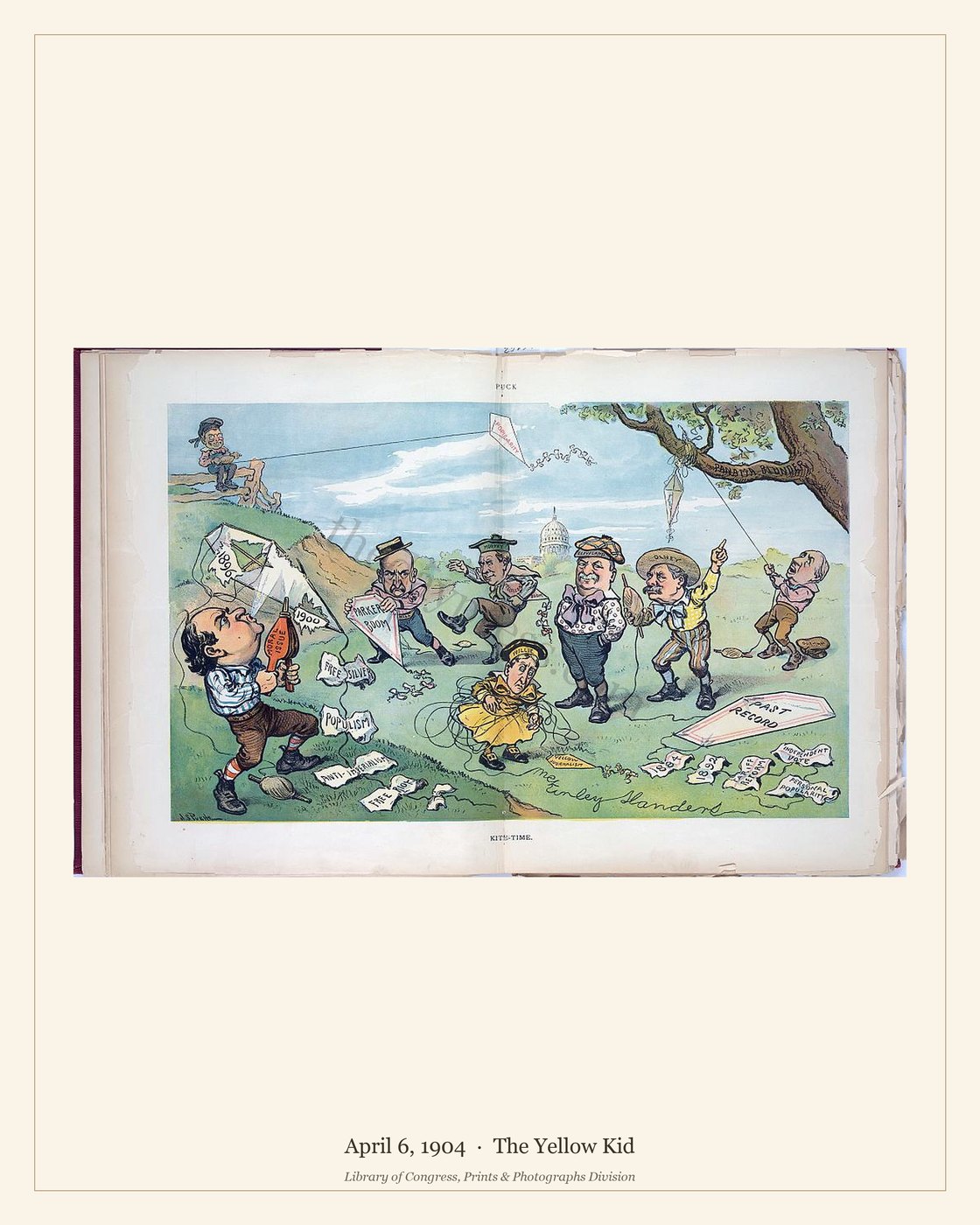
The competition was fierce enough that when Richard Outcault’s hit character moved from one paper to the other, both papers ran rival versions. The very term ‘yellow journalism’, for sensational circulation-chasing news, comes from the Yellow Kid at the centre of that fight.
The founding strips
Richard Outcault’s Yellow Kid, in the World’s ‘Hogan’s Alley’ from 1895, is usually credited as the first successful newspaper comic. Rudolph Dirks’s Katzenjammer Kids began in Hearst’s Journal in 1897, introducing the recurring cast and speech balloons that became standard. Outcault followed with Buster Brown in 1902, and Winsor McCay produced the visually astonishing Little Nemo in Slumberland from 1905 — among the most beautiful comics ever drawn.
Within a decade these strips had established the comic’s basic grammar: recurring characters, sequential panels, speech balloons, and the weekly Sunday colour page.
Why they still look striking
Printed large and in flat, brilliant colour, the early Sunday strips were designed to grab a reader across a breakfast table, and as prints they keep that graphic punch. They are also the origin point of a whole art form — everything in later comics traces back to these pages — which gives them a historical weight beyond their considerable charm.
McCay’s Little Nemo in particular is now recognised as a masterpiece of draughtsmanship and design, the equal of any illustration of its age.
Legacy
The Sunday comic strip was one of America’s original contributions to world visual culture. The founding strips of 1895–1905 invented a medium, and their colour pages remain vivid, funny, and unmistakably the source of everything that followed in comics.
The Sunday comic strips in our archive are restored from public-domain scans, each dated to the real page it appeared on. Browse the Sunday comic strips →
Frequently asked questions
What was the first American comic strip?
Richard Outcault’s Yellow Kid, from 1895 in the New York World, is usually credited as the first successful newspaper comic.
Why were comics in newspapers?
Colour comic supplements were a weapon in the 1890s circulation war between Pulitzer and Hearst — a way to sell papers.
Where does ‘yellow journalism’ come from?
From the Yellow Kid and the sensational Pulitzer–Hearst rivalry over him.
Which are the founding strips?
The Yellow Kid, the Katzenjammer Kids, Buster Brown, and Little Nemo in Slumberland.
Further reading
- Browse Sunday comic strips
- Browse magazine cover art
- Bill Blackbeard and Martin Williams, eds., The Smithsonian Collection of Newspaper Comics (Smithsonian Institution Press, 1977).
- R. C. Harvey, The Art of the Funnies: An Aesthetic History (University Press of Mississippi, 1994).
The Day Press curates, restores, and reformats public-domain American printed images from 1885 to 1928 for archival-quality home printing. Browse the archive · Browse by theme, month, decade.