In focus: Puck — January 27, 1909
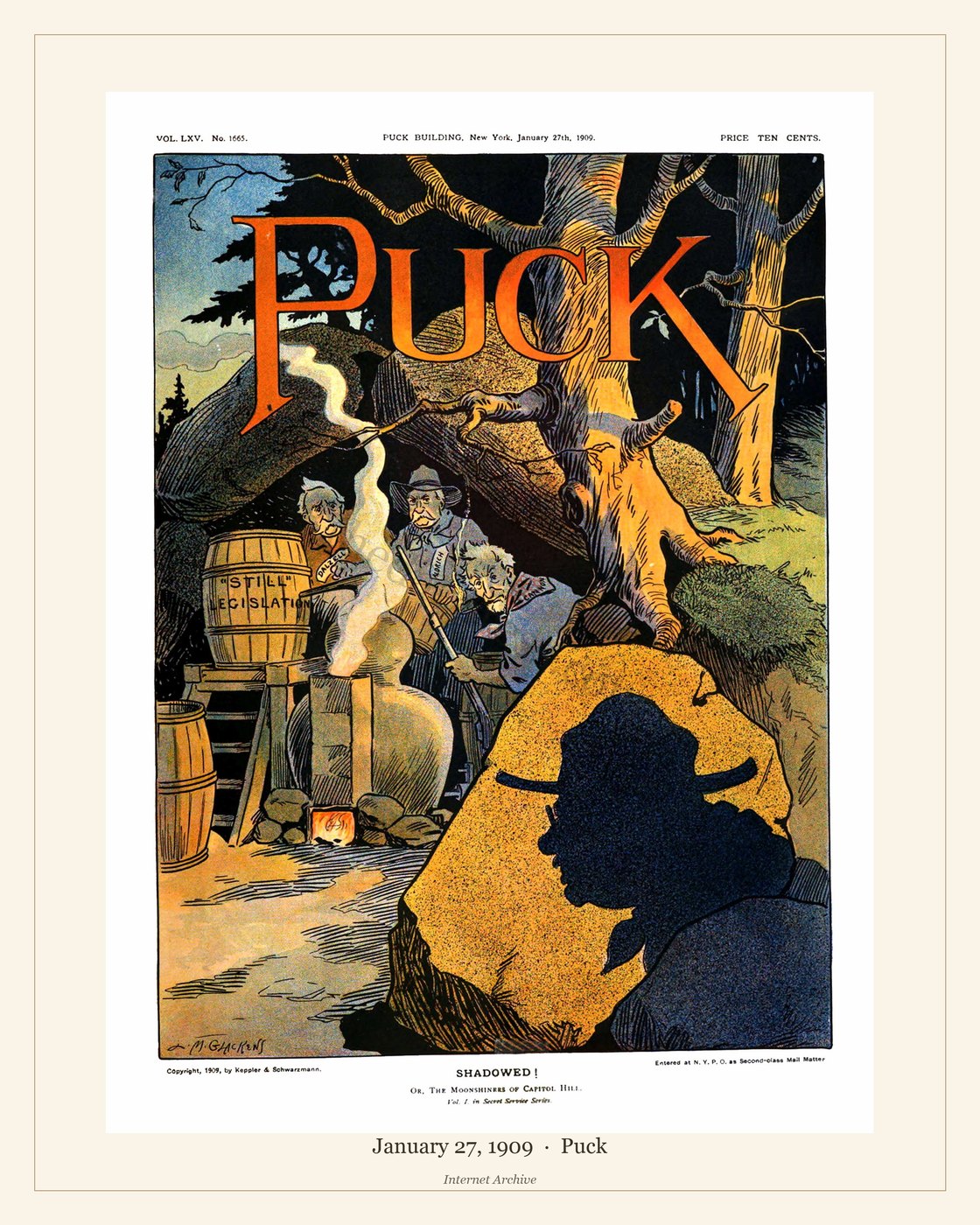
TL;DR — The Puck issue dated January 27, 1909 is a late-period cover from America’s first commercially successful colour cartoon weekly. Its date is a good occasion to explain what made Puck revolutionary: the Austrian-born cartoonist Joseph Keppler and the chromolithographic process that, for the first time, let a magazine put a full-page colour political cartoon on the newsstand every week. This piece covers Keppler, the technology, and where a 1909 Puck sits in the magazine’s long arc.
By The Day Press · Published November 2026
Joseph Keppler and the birth of Puck
Puck was the creation of Joseph Keppler (1838–1894), a Vienna-born cartoonist and actor who emigrated to the United States and tried twice to launch a satirical weekly before he succeeded. His German-language Puck began in St. Louis in 1876; the English-language edition followed in New York in 1877. It was the first American humour magazine to make the full-colour political cartoon its central feature and to sustain it commercially, and it ran until 1918.
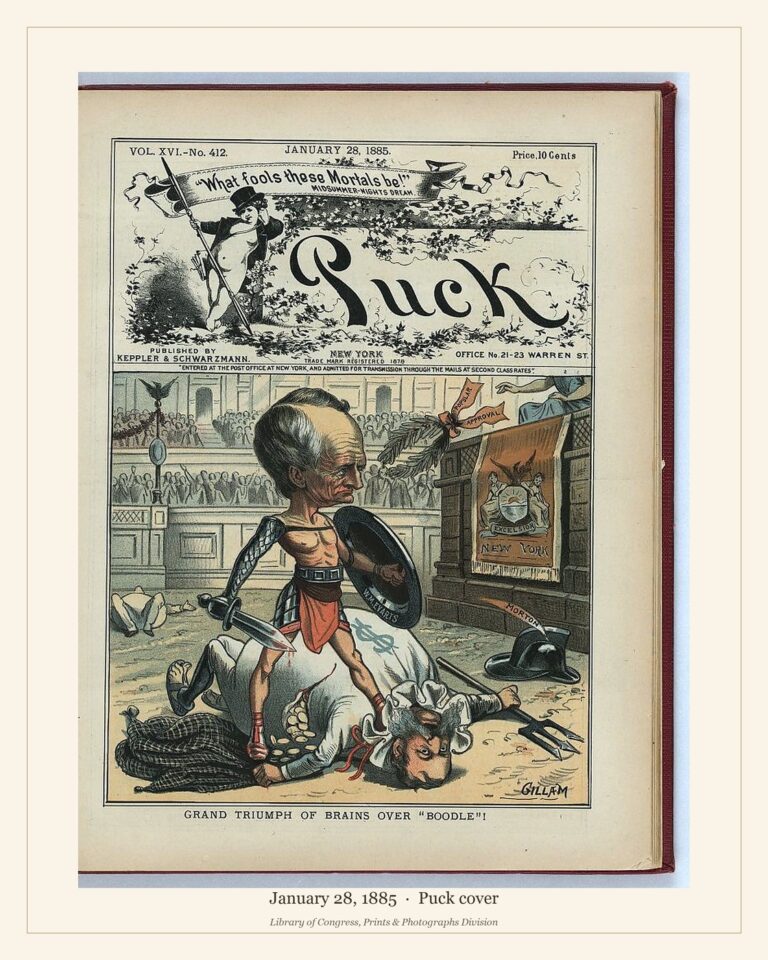
Keppler was both a gifted caricaturist and a shrewd editor. He drew many of the early covers and centrefolds himself, in a broad, energetic, allegorical style, and he built a staff of artists — among them Bernhard Gillam, Frederick Burr Opper, Louis Dalrymple, and later his own son Udo Keppler — who made Puck a visual force in American politics for four decades.
The technology: colour on the newsstand
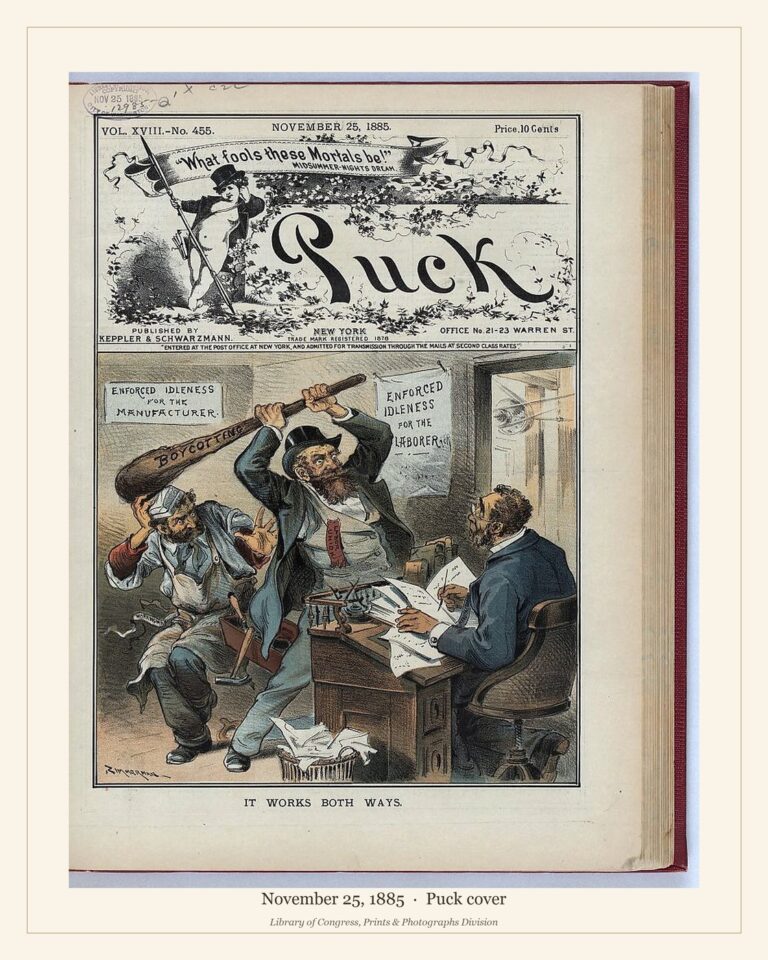
What made Puck possible was chromolithography — printing in colour from a series of prepared lithographic stones, one for each colour, layered in careful register. It was an expensive, skilled process, and applying it to a weekly magazine, at speed and scale, was a genuine feat. Before Puck, American political cartoons were black-and-white wood engravings, as in Harper’s Weekly; Puck put them in rich, saturated colour.
That colour was not decoration — it was argument. A full-page chromolithograph cartoon could be read across a crowded newsstand, its colour drawing the eye and its caricature landing its political point at a glance. Puck’s technical achievement and its political influence were the same thing: colour made the cartoon carry.
Puck’s political power
At its height in the 1880s Puck was a real force in national politics. Its relentless caricature of the Republican candidate James G. Blaine in the 1884 presidential election — Bernhard Gillam’s ‘tattooed man’ series, showing Blaine covered in the marks of his scandals — is often cited as cartooning that measurably shaped an election. Puck leaned Democratic and reformist, and it made and unmade reputations week by week.
By 1909, the date of this cover, Puck was past that political peak but still an institution, drawing the events of the day — the transition from Theodore Roosevelt to William Howard Taft, who took office that March — in the broad colour caricature that had been its signature for thirty years.
A dated colour cartoon
Puck’s cover cartoons are among the finest surviving examples of American chromolithography, and they are a colour record of the nation’s politics from the 1870s to the First World War. William Randolph Hearst bought the magazine in 1916, and it closed in 1918, which makes the whole run a finite, datable body of work.
Dated to January 1909, this cover belongs to the last decade of that run — a mature Puck, its colour technique perfected, its place in American political culture long established.
The Puck covers in our archive are restored from Library of Congress scans, each dated to the real issue it appeared on. Browse the Puck covers →
Frequently asked questions
Who founded Puck?
Joseph Keppler, a Vienna-born cartoonist who launched a German-language Puck in St. Louis in 1876 and the English-language edition in New York in 1877. It was the first American weekly to sustain full-colour political cartoons.
What made Puck’s colour possible?
Chromolithography — colour printing from a series of lithographic stones, one per colour. Applying it to a weekly magazine at scale was a real technical achievement, and it distinguished Puck from the black-and-white wood-engraved cartoons of the time.
Did Puck really influence elections?
Its caricature of James G. Blaine in the 1884 election — Bernhard Gillam’s ‘tattooed man’ series — is often credited with helping shape the result. Puck leaned Democratic and reformist.
When did Puck run?
The English-language Puck ran from 1877 to 1918; William Randolph Hearst bought it in 1916.
Further reading
- Browse Puck covers
- Browse magazine cover art
- Richard Samuel West, Satire on Stone: The Political Cartoons of Joseph Keppler (University of Illinois Press, 1988).
- Frank Luther Mott, A History of American Magazines (Harvard University Press, 1938–1968).
The Day Press curates, restores, and reformats public-domain American printed images from 1885 to 1928 for archival-quality home printing. Browse the archive · Browse by theme, month, decade.