In focus: Vogue — December 30, 1917
TL;DR — The Vogue issue dated December 30, 1917 is a year-end holiday number, one of the gift-and-hostess issues that closed Vogue’s seasonal calendar. It appeared at the end of the first full year of American involvement in the First World War, a winter of rationing and official thrift — which put Vogue’s tradition of luxurious holiday and gift coverage in visible tension with the national mood. This piece looks at the holiday number as an editorial form, at how the magazine reconciled luxury with wartime economy, and at the illustrated cover that fronted it.
By The Day Press · Published October 2026
The holiday number as an editorial form
Vogue’s seasonal calendar ended each year with its most commercially charged issues: the holiday-gift numbers and the hostess numbers, timed to the Christmas and New Year social season. These were, in a sense, Vogue at its most explicit — issues built around what to buy, what to give, and how to entertain, dense with the advertising that Condé Nast’s affluent-reader strategy commanded at exactly the moment his readers were spending.
A year-end issue like this one belonged to that tradition: party dress, gifts, the rituals of the season’s entertaining, all presented in the confident, moneyed register the magazine had made its own. The cover fronted the most lucrative weeks of Vogue’s year.
Luxury against a wartime winter
What makes the exact date interesting is the collision. This issue closed 1917, the first full year of the American war. It was a winter of visible official thrift: Herbert Hoover’s Food Administration had made ‘meatless’ and ‘wheatless’ days a patriotic routine, coal was short enough to force ‘heatless’ days early in 1918, and public life was saturated with the language of sacrifice and economy.
A holiday-gift number — Vogue’s most frankly acquisitive issue — landing in that winter is a small study in how a luxury magazine navigated the war. Vogue’s answer, across 1917 and 1918, was to reframe rather than retreat: to promote simpler entertaining, thoughtful rather than lavish gifts, and ‘fashions for limited incomes’, folding economy into elegance instead of opposing them. The holiday number persisted, but its rhetoric bent toward the moment.
The illustrated cover
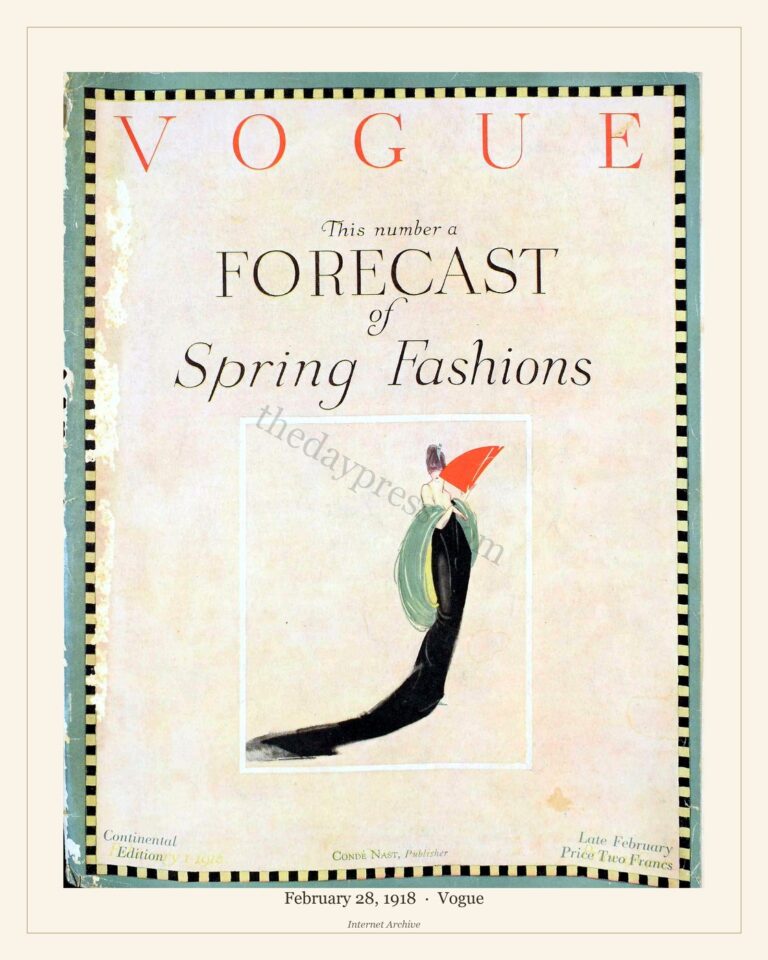
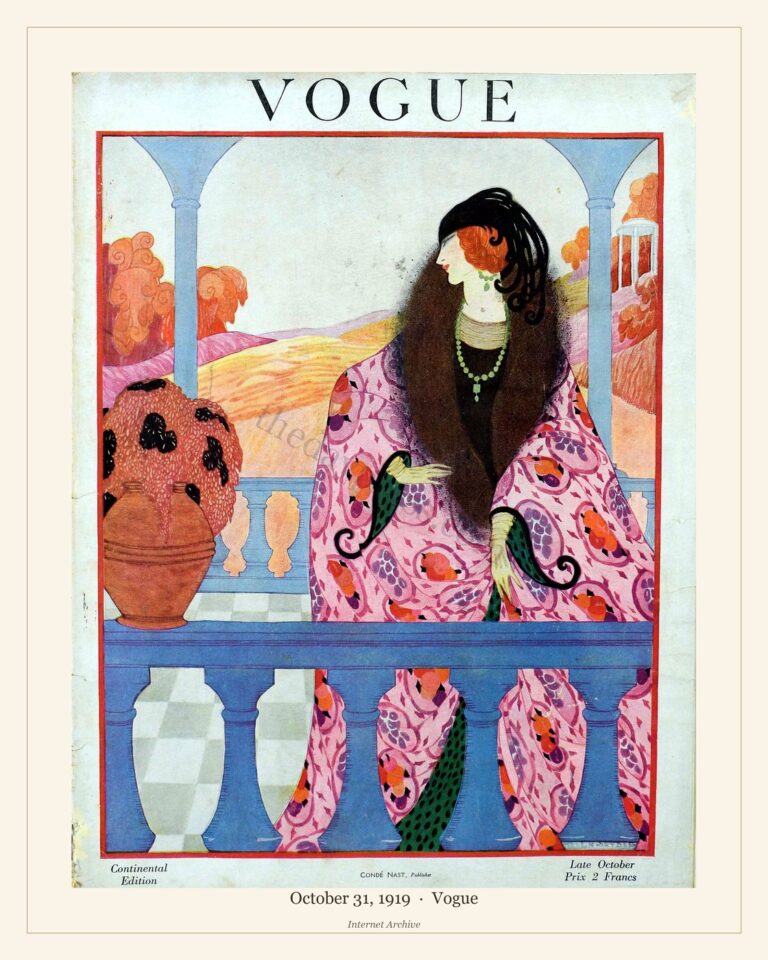
As with every Vogue cover from 1909 to 1932, the front of this issue was a commissioned drawing, not a photograph. Year-end covers leaned to the festive and the social, the work of the magazine’s regular artists — Helen Dryden, George Wolfe Plank, and their colleagues — whose decorative designs owed as much to poster art and the Ballets Russes as to fashion illustration.
The cover, then, is best read as an emblem of the season Vogue was selling rather than a picture of a specific garment or gift — which is precisely why it survives as an image a century later.
A dated piece of the illustrated era
Vogue’s drawn covers form a finite set, roughly 1909 to 1931, closed by the photographic cover of 1932. Dated to the last days of 1917, this one fixes the magazine’s grandest commercial issue to a very particular moment: the end of the first American war year, luxury and thrift held in the same frame.
The Vogue covers in our archive come from this illustrated era, each dated to the real issue it appeared on — a natural match for a December or New Year date. Browse the Vogue covers →
Frequently asked questions
What is a Vogue holiday number?
One of the year-end gift-and-hostess issues that closed Vogue’s seasonal calendar, built around holiday dress, gifts, and entertaining — among the magazine’s most advertising-dense issues.
How did Vogue handle wartime thrift?
By reframing rather than abandoning luxury: it promoted simpler entertaining, thoughtful gifts, and ‘fashions for limited incomes’, folding economy into elegance through 1917–18.
Why were there issues dated both December 30 and 31, 1917?
Vogue was a semi-monthly, so the end of the year could carry two closely-dated numbers — a consequence of its twice-a-month schedule, not an error.
Is the cover illustrated?
Yes — every Vogue cover between 1909 and 1932 was drawn or painted, not photographed.
Further reading
- Browse Vogue covers
- Browse New Year cards
- Caroline Seebohm, The Man Who Was Vogue: The Life and Times of Condé Nast (Viking, 1982).
- Norberto Angeletti and Alberto Oliva, In Vogue: The Illustrated History of the World’s Most Famous Fashion Magazine (Rizzoli, 2006).
The Day Press curates, restores, and reformats public-domain American printed images from 1885 to 1928 for archival-quality home printing. Browse the archive · Browse by theme, month, decade.