The original Life: satire before the photo magazine
TL;DR — Before it was a photo magazine, Life was a weekly of humour and satire — founded in 1883, published until 1936, when Henry Luce bought the name for his new picture magazine. The original Life launched the Gibson Girl, set a standard of witty pen-and-ink illustration, and served as America’s answer to Britain’s Punch. This survey tells the story of that first Life: its founding by John Ames Mitchell, its distinct place among the humour weeklies, and its long afterlife.
By The Day Press · Published September 2026
Two magazines, one name
The confusion is worth clearing first. The Life famous for black-and-white photojournalism began only in 1936, when Henry Luce bought the title. The original Life was a different and older magazine: an illustrated weekly of humour and satire founded in New York in 1883 and published for over fifty years before Luce acquired the name. The two share nothing but the word on the masthead.
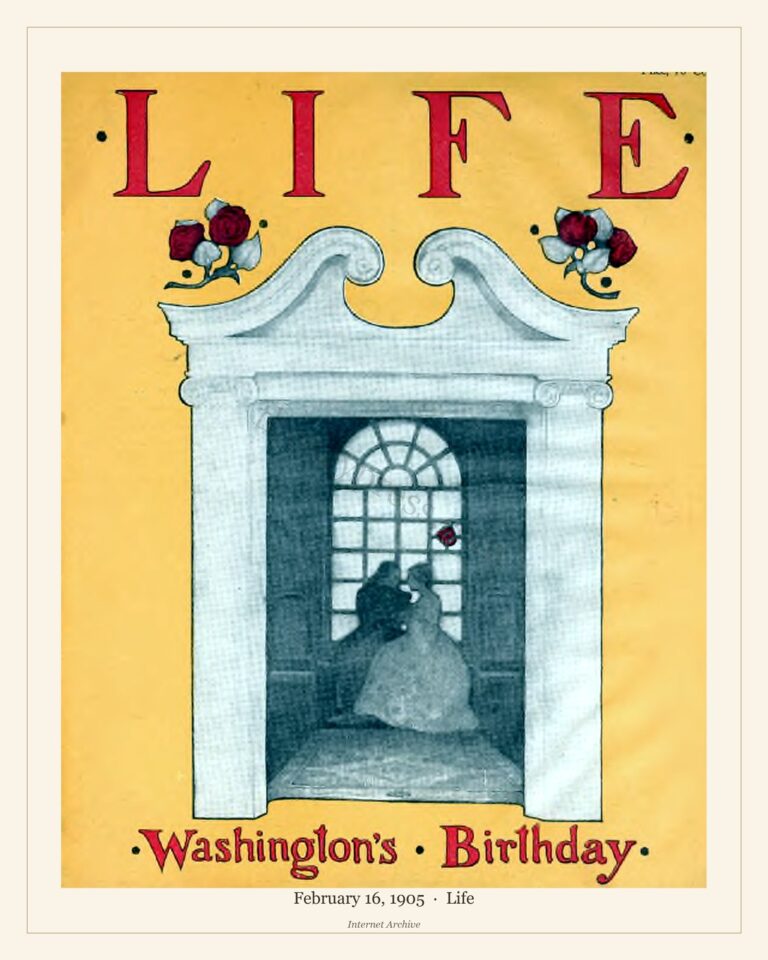
To read a Life cover from 1905 or 1915 correctly is to know it belongs to the first magazine — a weekly of wit and drawing, not of news photography.
Mitchell’s magazine
Life was founded by John Ames Mitchell (1845–1918), an artist and architect who used a modest inheritance to launch it in 1883 with the businessman Andrew Miller. Mitchell modelled Life on the London humour magazine Punch: literate, elegantly drawn, socially observant, aimed at a cultivated readership rather than at the broad political audience of Puck and Judge.
He backed taste and wit over partisanship, and used the magazine for personal causes — notably a long campaign against vivisection. The result was the wittiest and most stylish of the American humour weeklies, and a tastemaker for the educated classes.
The Gibson Girl and a school of illustrators
Life’s greatest legacy is the Gibson Girl, Charles Dana Gibson’s pen-and-ink ideal of turn-of-the-century American womanhood, which first took hold in its pages in the 1890s and became a national craze. But Gibson worked amid a deep bench of talent — A. B. Frost, Oliver Herford, Palmer Cox, and others — that made Life a showcase of American comic draughtsmanship.
Its social comedy, unlike the topical politics of Puck and Judge, gave it a longer cultural reach: Life’s covers and cartoons defined an urbane American sense of humour that persisted for decades.
Decline and the passing of the name
The original Life thrived into the 1920s but faded with the general decline of the illustrated humour weekly. In 1936 its owners sold the name to Henry Luce, who wanted it for his new photographic magazine; the old Life ceased, and the prestige it had built over fifty years passed to a wholly different publication. The covers of the first Life remain a record of American wit and illustration at their height.
The original Life covers in our archive are all from this satirical era, each dated to the real issue it appeared on. Browse the Life covers →
Frequently asked questions
Is this the same as the photo Life magazine?
No. The original Life was a satirical humour weekly (1883–1936). Henry Luce bought only the name in 1936 for his picture magazine; the two are otherwise unrelated.
Who founded the original Life?
The artist John Ames Mitchell, in 1883, modelling it on the British humour magazine Punch.
What was it best known for?
Launching the Gibson Girl and setting a high standard of witty pen-and-ink illustration and social satire.
When did it end?
The original Life ran until 1936, when the name passed to Luce.
Further reading
- Browse Life covers
- Browse magazine cover art
- Frank Luther Mott, A History of American Magazines (Harvard University Press, 1938–1968).
- Susan E. Meyer, America’s Great Illustrators (Abrams, 1978).
The Day Press curates, restores, and reformats public-domain American printed images from 1885 to 1928 for archival-quality home printing. Browse the archive · Browse by theme, month, decade.