In focus: Vogue — February 28, 1918
TL;DR — The Vogue issue dated February 28, 1918 is a spring-forecast number from the final winter of the First World War. Its date is a good occasion to explain one of Vogue’s defining editorial functions: the reporting of the Paris ‘openings’, the twice-yearly couture collections that set world fashion, and the ‘forecast’ issues that translated them for American readers. This piece covers how that reporting worked, how the war disrupted it, and the illustrated cover that fronted the spring-forecast number.
By The Day Press · Published November 2026
The Paris openings and the ‘forecast’ issue
For its first several decades Vogue’s authority rested on a single privileged relationship: its access to the Paris couture houses. Twice a year, in spring and autumn, the great houses — Worth, Paquin, Poiret, and their peers — showed their new collections at the ‘openings’, and these shows dictated what fashionable women everywhere would wear. Vogue’s job was to witness the openings and carry them to America.
The ‘Forecast of Spring Fashions’ and its autumn counterpart were the issues built around this. A late-February number like this one was a forecast issue: it previewed the spring silhouettes, colours, and lines just as the Paris houses were revealing them, giving American readers — and the dressmakers who served them — the season’s direction before the clothes themselves could cross the Atlantic.
War on the supply line from Paris
The war strained this Paris-to-New-York pipeline badly. Transatlantic shipping was dangerous and restricted, several couture houses curtailed or reorganised their operations, and the flow of information and garments that Vogue depended on became unreliable. It was precisely this disruption that had pushed Vogue’s editor Edna Woolman Chase to stage a New York show of American designers in 1914.
By the last winter of the war, in early 1918, the forecast issue carried on but under strain — and increasingly shared its pages with the magazine’s wartime themes of thrift and simpler dress. The spring it forecast would be the war’s last; the Armistice came that November.
The illustrated cover
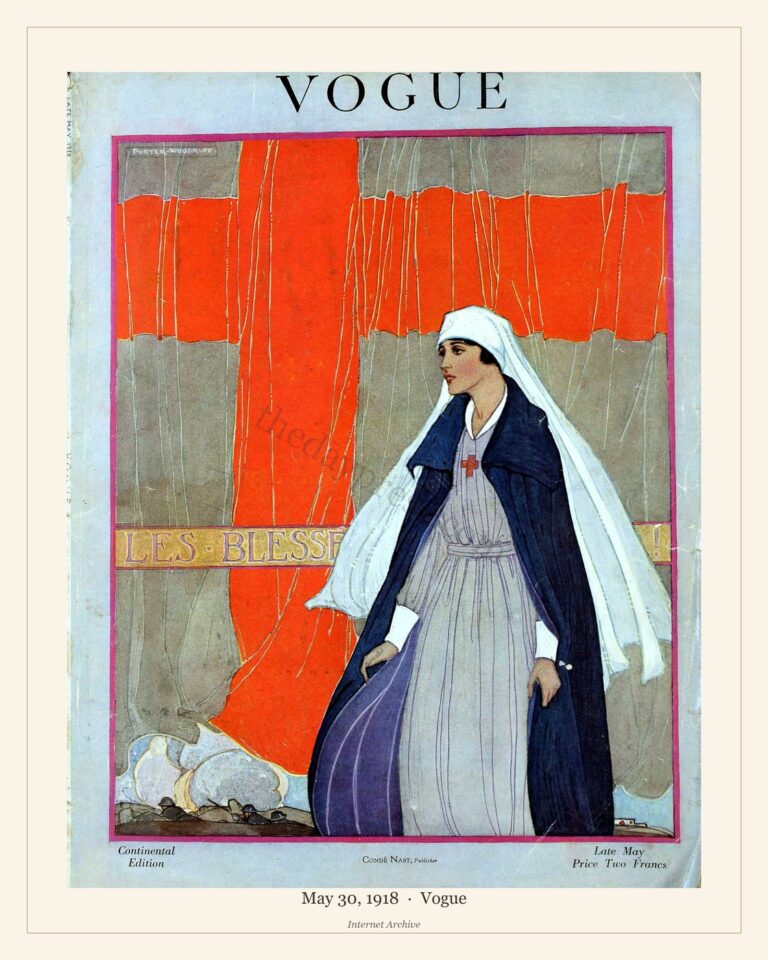
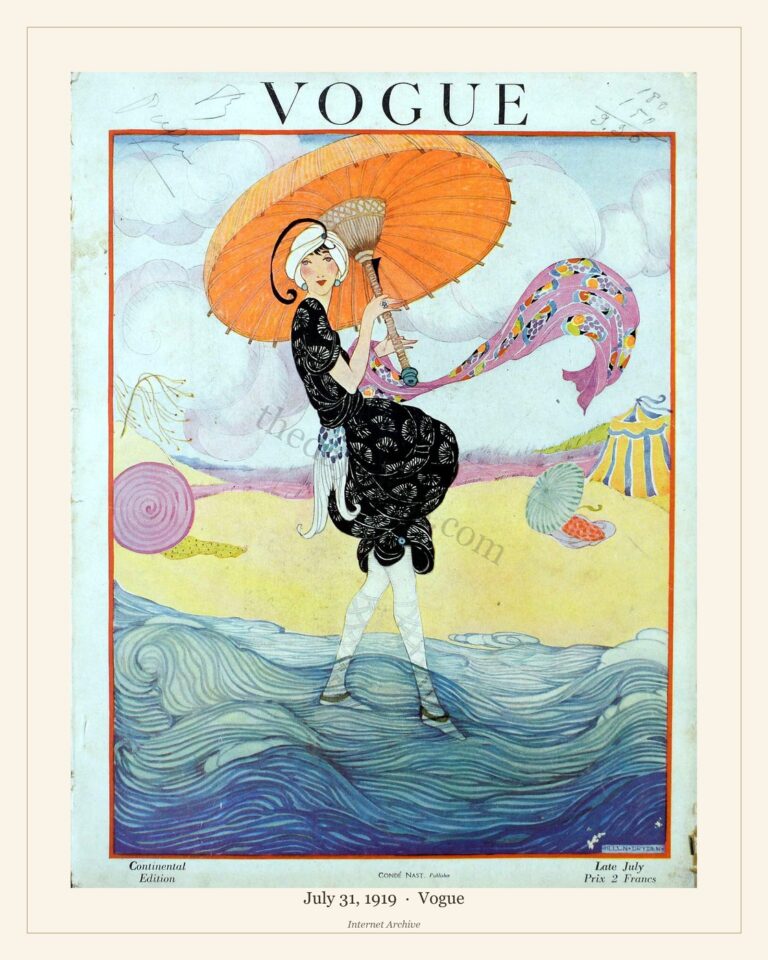
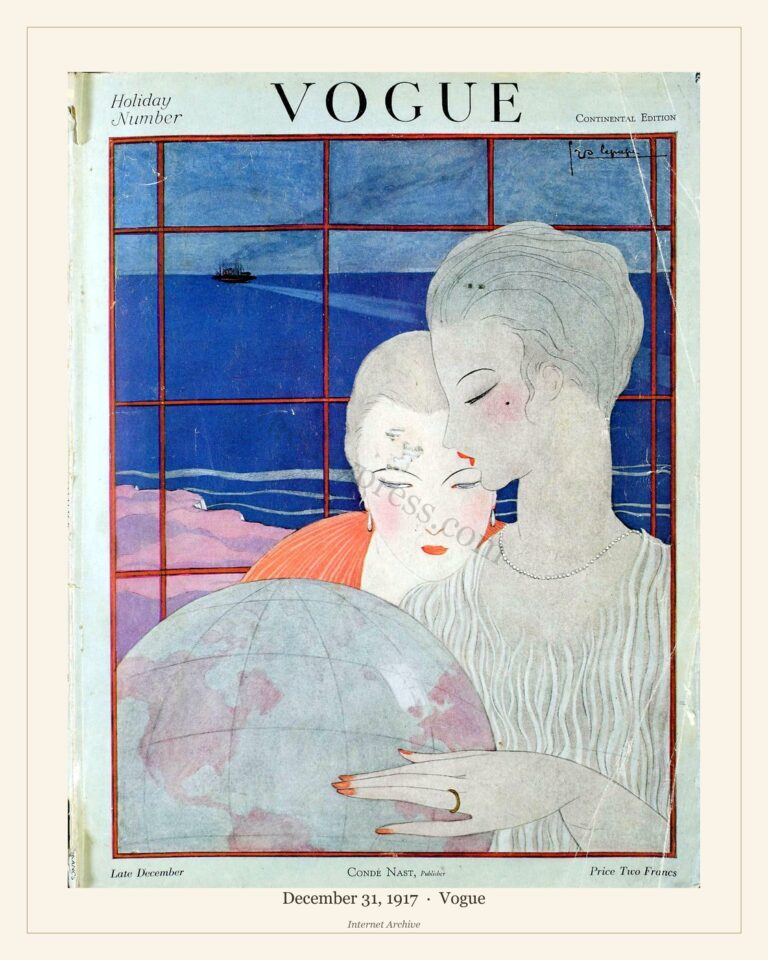
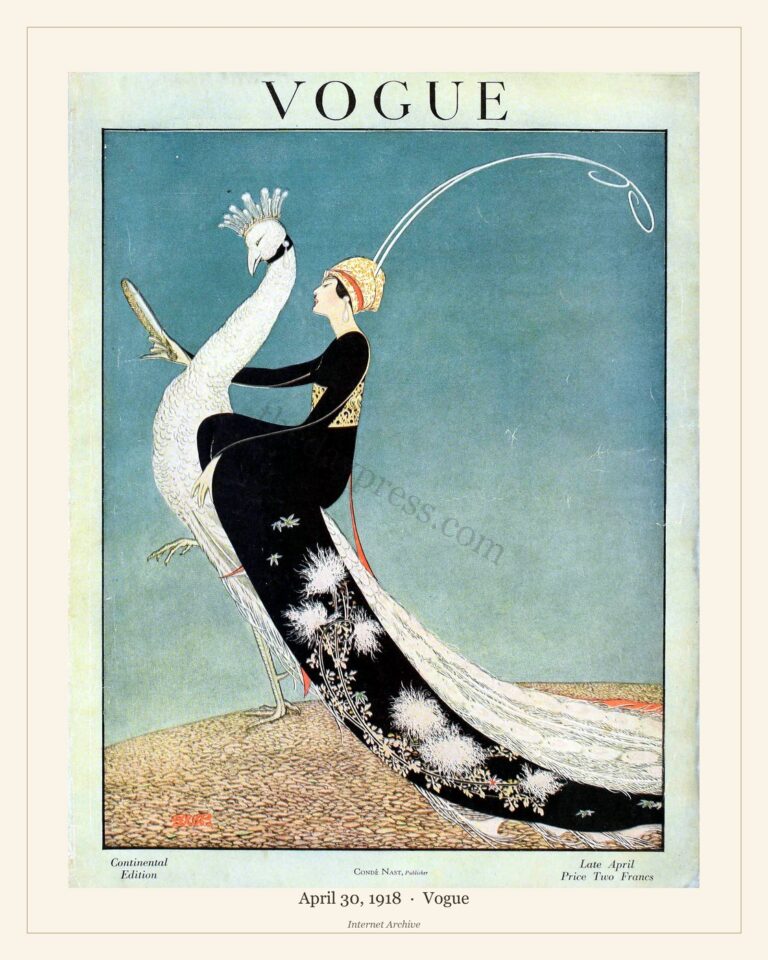
The cover of a spring-forecast issue, like every Vogue cover between 1909 and 1932, was a commissioned illustration. Its decorative, flattened style — the work of artists such as Helen Dryden and George Wolfe Plank — owed as much to the theatrical poster and the Ballets Russes as to the older fashion plate, which is what lets these covers stand as graphic art rather than costume reference.
A forecast cover signalled spring as a mood and a promise, not as a catalogue of specific garments — the reason it still reads as an image when the season’s actual clothes are a century gone.
A dated cover from a finite tradition
Vogue’s illustrated covers span roughly 1909 to 1931, ended by the photographic cover of 1932. Dated to late February 1918, this spring-forecast cover fixes one turn of the magazine’s Paris-driven seasonal machine to the final winter of the First World War.
The Vogue covers in our archive are drawn from this illustrated era, each dated to the real issue it appeared on. Browse the Vogue covers →
Frequently asked questions
What were the Paris ‘openings’?
The twice-yearly showings of the new couture collections in Paris, in spring and autumn, which set world fashion. Vogue’s authority rested on reporting them to American readers.
What is a Vogue ‘forecast’ issue?
A seasonal issue — the Forecast of Spring Fashions and its autumn equivalent — that previewed the new Paris silhouettes and colours for readers and dressmakers ahead of the season.
How did the war affect Vogue’s Paris coverage?
It disrupted the shipping and the couture houses Vogue depended on, which helped push editor Edna Woolman Chase to stage a New York show of American designers in 1914.
Is the cover illustrated?
Yes — every Vogue cover from 1909 to 1932 was drawn or painted, not photographed.
Further reading
- Browse Vogue covers
- Browse magazine cover art
- Norberto Angeletti and Alberto Oliva, In Vogue: The Illustrated History of the World’s Most Famous Fashion Magazine (Rizzoli, 2006).
- Edna Woolman Chase and Ilka Chase, Always in Vogue (Doubleday, 1954).
The Day Press curates, restores, and reformats public-domain American printed images from 1885 to 1928 for archival-quality home printing. Browse the archive · Browse by theme, month, decade.