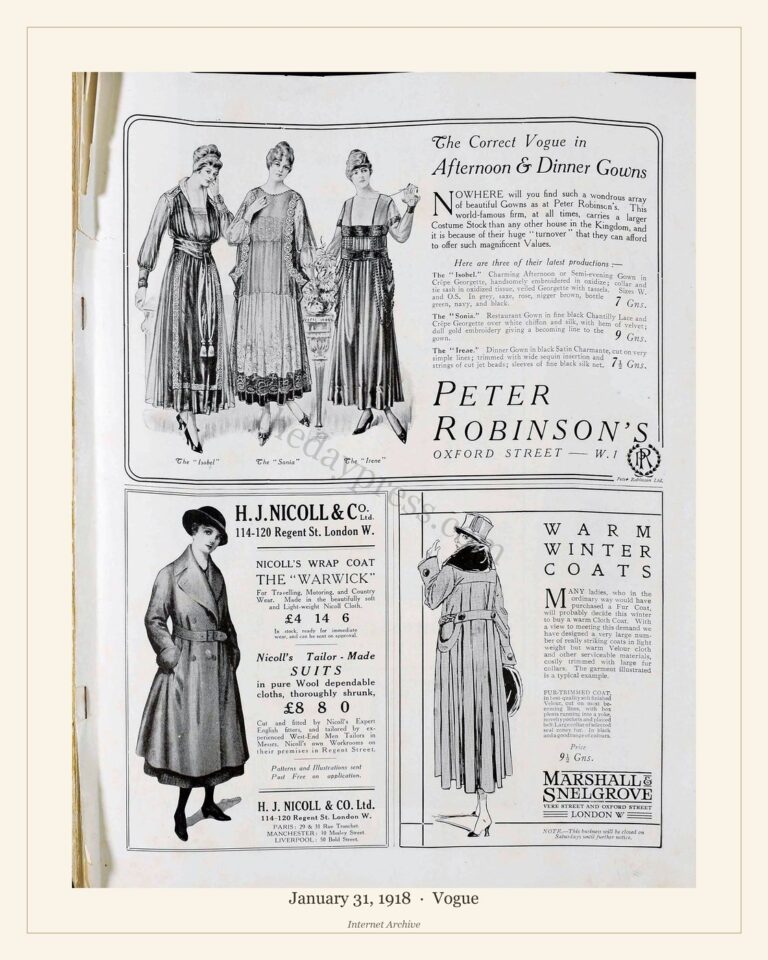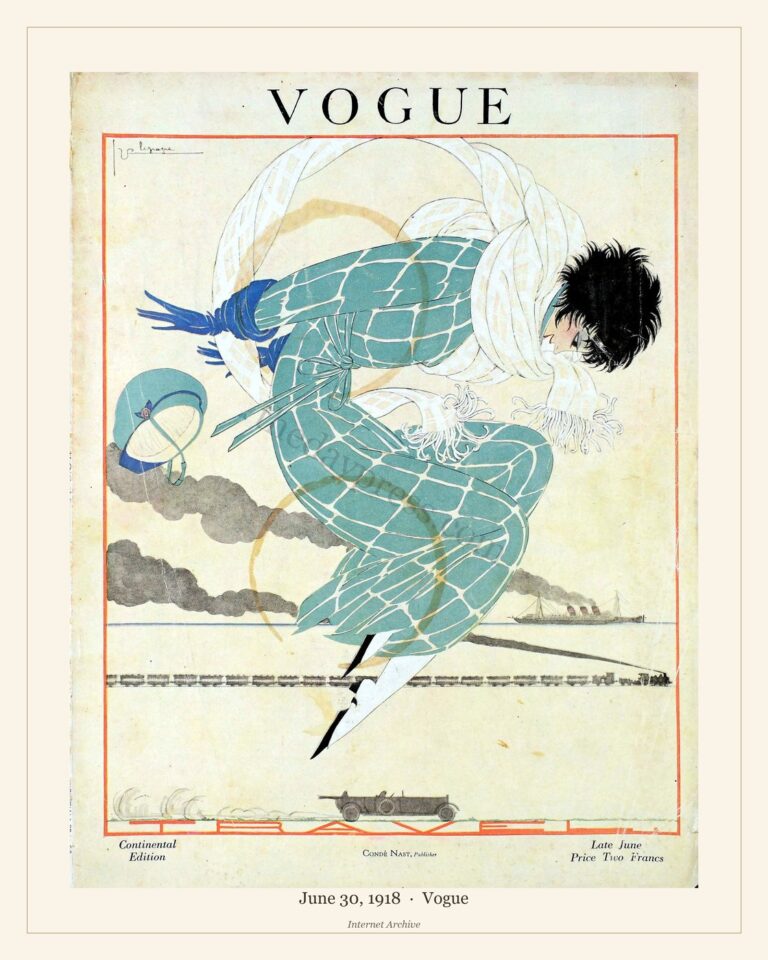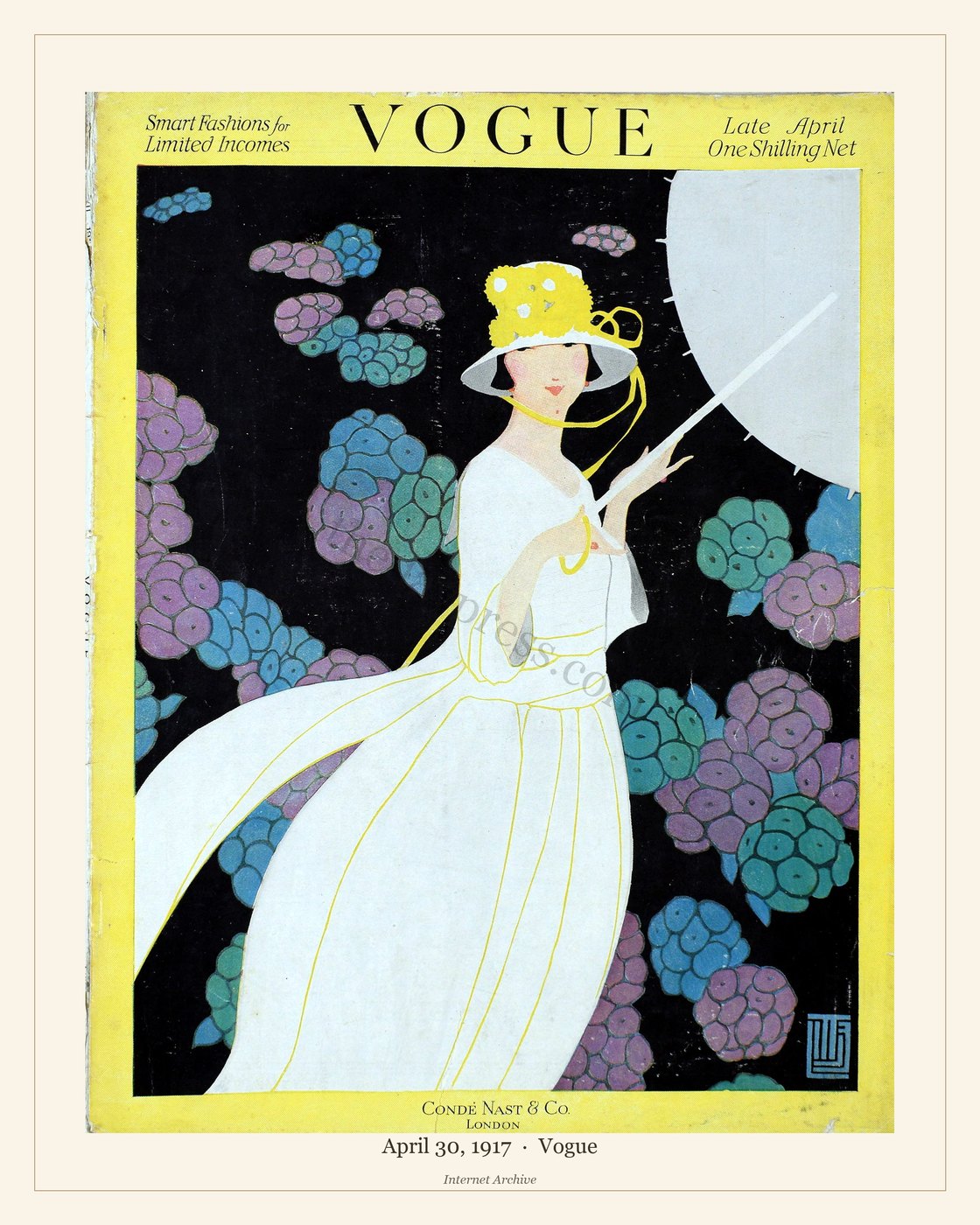
In focus: Vogue — April 30, 1917
TL;DR — The Vogue issue dated April 30, 1917 appeared three weeks after the United States entered the First World War on April 6. It belongs to the magazine’s illustrated-cover era — the roughly 1909–1932 window between Condé Nast’s purchase of Vogue and the arrival of the photographic cover — when the front of every issue was a drawing, not a photograph, and a small group of artists (Helen Dryden, George Wolfe Plank, Georges Lepape) turned the American fashion magazine into a vehicle for modern graphic art. This piece explains what that cover programme was, why the spring of 1917 was a strange moment to be selling fashion, and why the drawn Vogue covers of these years are now collected as art in their own right.
By The Day Press · Published July 2026
Vogue in 1917: a fashion authority remade by Condé Nast
Vogue was founded in 1892 by Arthur Baldwin Turnure as a weekly gazette of New York society — a slim journal of the city’s clubs, weddings, and manners, with fashion only one subject among several. It was a modest publication read by a few thousand people in a single city. The Vogue of April 1917 was a different animal entirely, and the difference had one principal cause: Condé Montrose Nast, who bought the magazine in 1909 and spent the next two decades turning it into the most influential fashion publication in the world.
Nast’s method was what he later called ‘class publishing’ — deliberately courting a narrow, affluent readership and charging advertisers a premium to reach it, rather than chasing the largest possible circulation. He raised the price, thickened the paper, moved the magazine to a semi-monthly schedule, and invested heavily in the visible quality of the object: the photography inside, the typography, and above all the cover. Under his editor Edna Woolman Chase, who ran the magazine from 1914 to 1952, Vogue became the arbiter of what fashionable American women wore, and the cover became its calling card.
By 1917 the formula was set. Vogue appeared twice a month, each issue built around a seasonal theme — spring fashions, hot-weather fashions, the autumn forecast, the holiday number — and each led with a commissioned illustration. The issue dated April 30, 1917 was one of the spring fashion numbers, published at the turn from the winter social season to summer.
The drawn cover: Vogue as a gallery of modern illustration
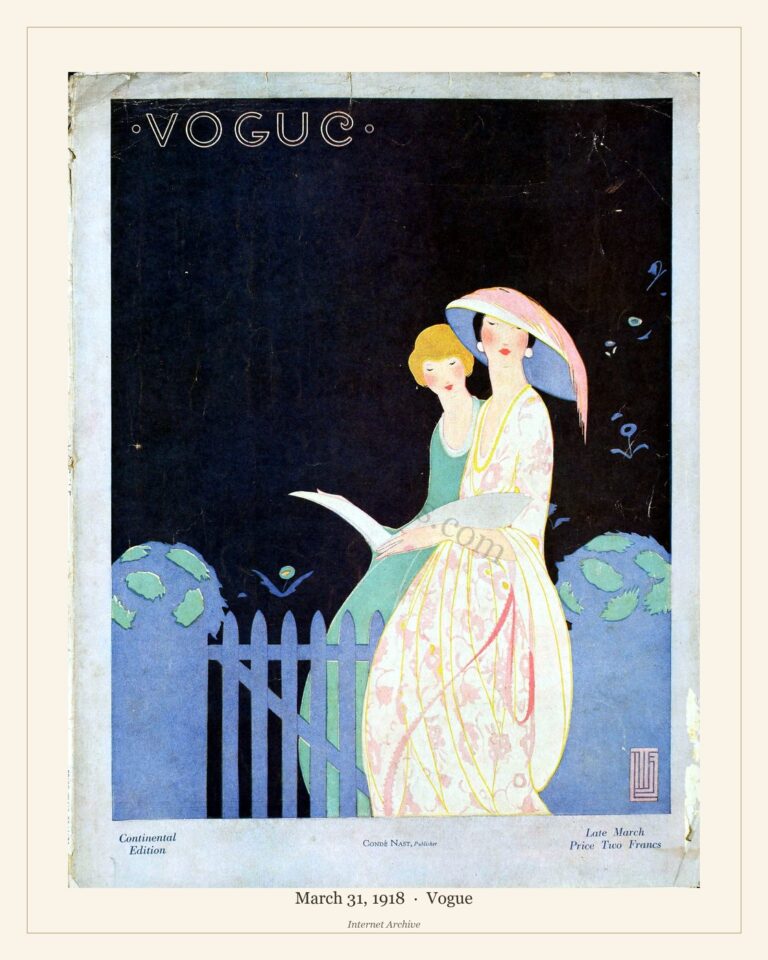
What sets the Vogue covers of this period apart — and what makes an original a piece of graphic art rather than a fashion photograph — is that they were drawn and painted by hand. Between Nast’s purchase in 1909 and 1932, when Edward Steichen’s photograph of a woman holding a beach ball became the first photographic Vogue cover, the front of every issue was the work of an illustrator.
The artists Nast assembled were among the finest commercial designers of the era. Helen Dryden, one of the highest-paid women artists in America at her peak, produced dozens of Vogue covers in a decorative, fluid style. George Wolfe Plank brought a jewelled, fantastical sensibility — peacocks, moons, elaborate borders. Georges Lepape and, a little later, Eduardo Garcia Benito imported the flat colour and geometric daring of the Paris avant-garde; Lepape had already illustrated the couturier Paul Poiret’s albums before he came to Vogue. Their covers owed as much to the theatrical poster, the Ballets Russes, and the emerging Art Deco style as to the older tradition of the fashion plate.
This matters for how a modern viewer should read the cover. It was not a report on a garment; it was a designed image, meant to convey mood and modernity across a crowded newsstand. The woman on a 1917 Vogue cover is an emblem, not a mannequin — which is exactly why these covers survive as art when the season’s actual dresses are long forgotten.
April 1917: selling spring fashion in the first weeks of war
The date on this cover places it at a genuine hinge in American history. Congress declared war on Germany on April 6, 1917, ending nearly three years of official neutrality; this issue reached its readers while the country was mobilising, drafting an army, and reorganising its economy for war. A fashion magazine dated three weeks into that upheaval sits in an odd and revealing position.
Vogue’s response over 1917 and 1918 was not to abandon fashion but to reconcile it with the war. The magazine ran features on ‘fashions for limited incomes’, on simpler silhouettes that used less material, and on the practical wartime wardrobe; it promoted thrift and, through the Vogue Pattern Company — which had grown out of the magazine’s earlier sale of dress patterns — encouraged women to make clothes at home. The elegance stayed, but it was increasingly framed as a patriotic economy rather than pure display.
There is a temptation, with a cover dated so precisely into a famous moment, to read the war into the image itself. It is worth resisting. Most Vogue covers of 1917 depict the season’s idea of style, not the front; the value of the date is that it locates the object in real history, not that it makes the drawing a piece of war reportage. The honest statement is the interesting one: this is what the most influential fashion magazine in America chose to put on its cover in the first weeks of the country’s war.
Why the drawn Vogue covers are collected today
The illustrated Vogue cover was a finite tradition. It began, in its mature form, with Nast’s investment after 1909 and effectively ended in the early 1930s, when photography — cheaper to reproduce, and newly capable of colour and glamour under Steichen and his successors — took the cover for good. Everything drawn falls into a roughly twenty-three-year window, which is part of why these covers are now studied and collected as a coherent body of work rather than as incidental commercial ephemera.
They also sit at the centre of a serious scholarly interest in how the magazine cover shaped modern ideas of womanhood and style. The Vogue covers of the 1910s and 1920s are, in the art-historical account, where European modernism entered American popular visual culture — the point at which Deco geometry and Ballets Russes colour reached the newsstand. An original, restored and framed, is a small piece of that history.
The Vogue covers in our archive come from exactly this illustrated era, dated to the real issue each one appeared on. Browse the Vogue covers →
Frequently asked questions
Were Vogue covers really illustrations, not photographs?
Yes. From Condé Nast’s purchase in 1909 until 1932, every Vogue cover was a drawing or painting. Edward Steichen’s July 1932 photograph is generally cited as the first photographic Vogue cover; the illustrated tradition this issue belongs to ended shortly afterward.
Who owned and edited Vogue in 1917?
Condé Nast had owned it since 1909, and Edna Woolman Chase was editor-in-chief from 1914 to 1952. Nast’s ‘class publishing’ strategy — a small, affluent readership and premium advertising — defined the magazine’s character in these years.
Does the cover depict the First World War?
Almost certainly not directly. Vogue’s covers in 1917 depicted the season’s idea of style; the war shaped the magazine’s editorial content (thrift, simpler dress, home sewing) more than its cover imagery. The April 6, 1917 declaration of war is the historical context of the date, not a description of the drawing.
Who were the main Vogue cover artists of this period?
Helen Dryden, George Wolfe Plank, Georges Lepape, and, from around 1920, Eduardo Garcia Benito, among others. Lepape and Benito in particular brought the flat colour and geometry of the Paris avant-garde to the American newsstand.
Further reading
- Browse Vogue covers
- Browse magazine cover art
- Caroline Seebohm, The Man Who Was Vogue: The Life and Times of Condé Nast (Viking, 1982).
- Carolyn Kitch, The Girl on the Magazine Cover: The Origins of Visual Stereotypes in American Mass Media (University of North Carolina Press, 2001).
The Day Press curates, restores, and reformats public-domain American printed images from 1885 to 1928 for archival-quality home printing. Browse the archive · Browse by theme, month, decade.