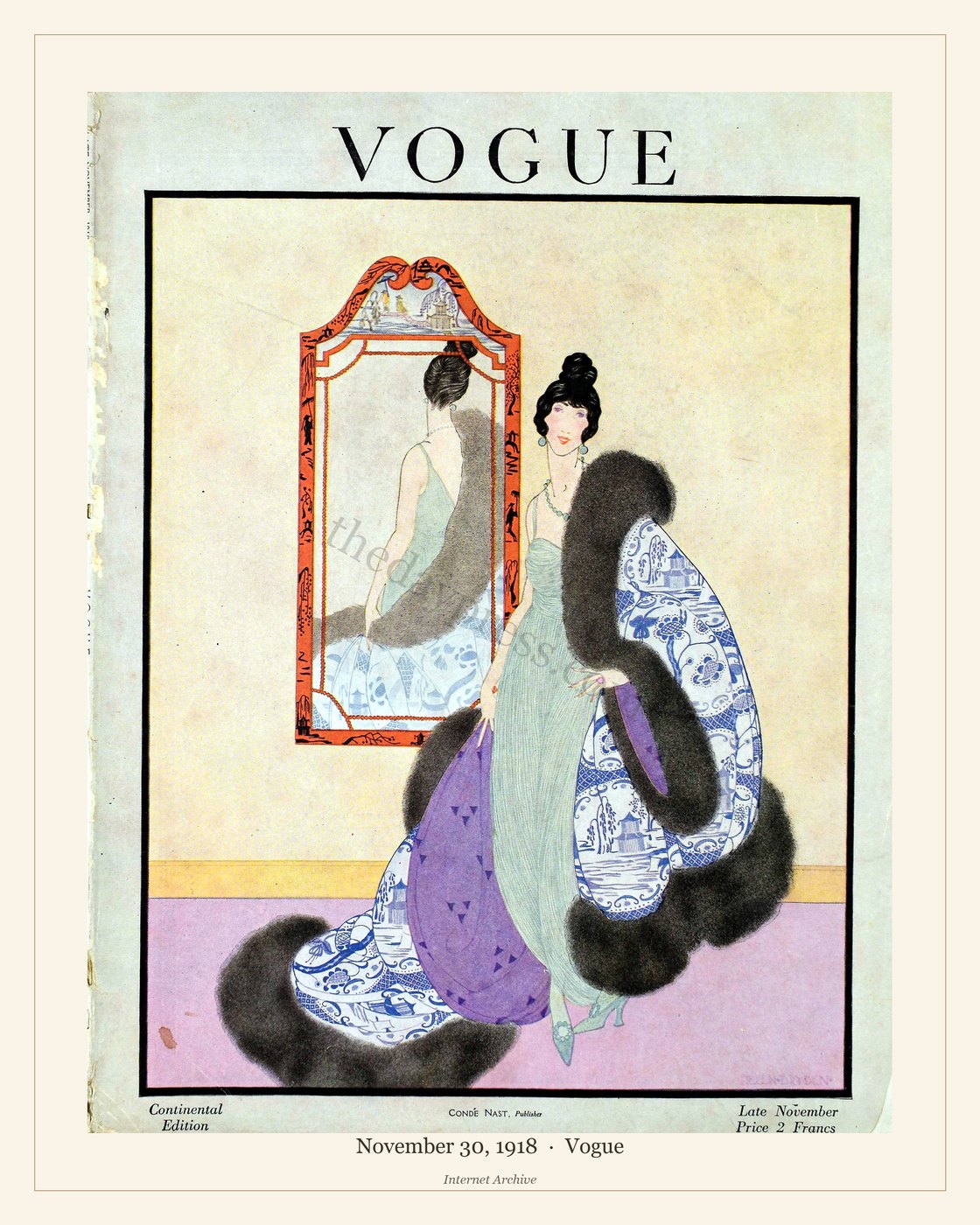
In focus: Vogue — November 30, 1918
TL;DR — The Vogue issue dated November 30, 1918 is one of the first published after the Armistice ended the First World War on November 11. It sits exactly on the hinge between the wartime magazine and the exuberant Vogue of the 1920s. This piece explains how the end of the war released the social and stylistic energy that produced the Jazz Age — shorter skirts, the bob, the modern woman — and how a magazine dated nineteen days into the peace stands at the start of that transformation.
By The Day Press · Published September 2026
Nineteen days into the peace
The Armistice of November 11, 1918 ended more than four years of war, and the change in mood was immediate and profound. This Vogue, dated November 30, reached readers in the first weeks of peace — as the blackouts lifted, the troops began to return, and a society that had spent years in mourning and thrift turned, almost at once, toward celebration.
A winter number in these weeks looked ahead to a holiday and social season that could resume without wartime restraint for the first time since 1914. It is a document of a specific and rare emotional moment: the exhalation after a long catastrophe.
The war’s end and the birth of the 1920s look
The fashion revolution of the 1920s did not appear from nowhere; it was released by the war. The practical, simplified, shorter-skirted dress that necessity had imposed during the conflict became, in peacetime, a positive style. Women who had worked, voted in several countries, and moved freely during the war did not return to the corseted, elaborate silhouette of 1913. Within a few years the bob, the dropped waist, the short skirt, and the flapper would define the decade.
Vogue stood to document all of it, and its covers changed accordingly — the decorative styles of the 1910s giving way, through the early 1920s, to the sleek geometry of Art Deco under artists like Georges Lepape and Eduardo Benito. A cover dated to the first weeks of peace stands right at the start of that arc.
The illustrated cover
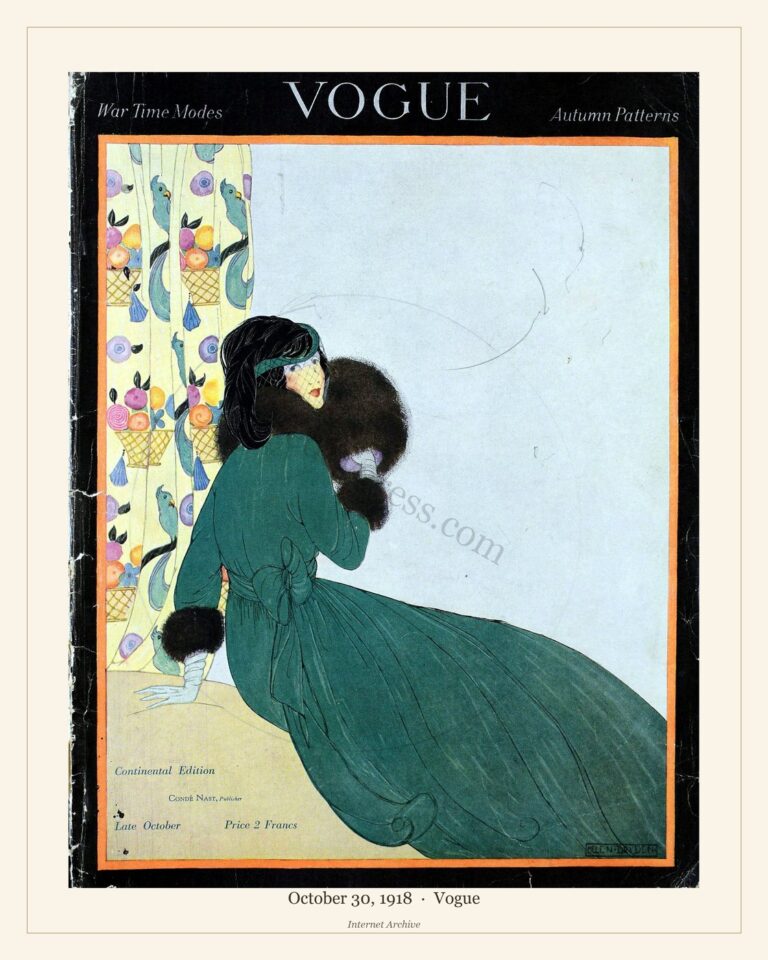
The cover, like every Vogue cover from 1909 to 1932, was a commissioned drawing in the magazine’s decorative house style. Its subject was the idea of the season and the moment, not a specific garment — which is why it survives as an image, and why its date, on the threshold of the 1920s, gives it particular resonance.
The Lost Generation behind the party
The exuberance of the 1920s had a shadow, and it is worth remembering alongside the glamour. The young people who came of age in the war were what Gertrude Stein called — in a phrase Ernest Hemingway made famous — the ‘Lost Generation’: marked by mass death, disillusioned with the old certainties, and determined to live intensely in the aftermath. The decade’s frantic gaiety was, in part, a response to trauma.
Vogue chronicled the surface of that world — the parties, the fashions, the freedom — but the surface sat on a real foundation of loss. A cover from the first weeks of peace in 1918 stands at the very start of that complicated release, when a grieving society turned, almost defiantly, toward pleasure.
A dated cover from the illustrated era
Vogue’s drawn covers form a finite body of work, roughly 1909 to 1931, closed by the photographic cover of 1932. Dated to the first weeks of peace in 1918, this one marks the turn from the wartime magazine to the Jazz Age Vogue that followed.
The Vogue covers in our archive span this turn from war to the 1920s, each dated to the real issue it appeared on. Browse the Vogue covers →
Frequently asked questions
When did the First World War end?
The Armistice took effect on November 11, 1918. This issue, dated November 30, is one of the first Vogue numbers published in the peace.
How did the war lead to 1920s fashion?
The simplified, shorter, more practical dress imposed by wartime necessity became, in peacetime, a positive style — giving rise to the bob, the dropped waist, and the flapper of the 1920s.
How did Vogue’s covers change afterward?
The decorative styles of the 1910s gave way through the early 1920s to the sleek Art Deco geometry of artists like Georges Lepape and Eduardo Benito.
Is the cover a drawing?
Yes — every Vogue cover from 1909 to 1932 was illustrated, not photographed.
Further reading
- Browse Vogue covers
- Browse magazine cover art
- Valerie Steele, Paris Fashion: A Cultural History (Oxford University Press, 1988).
- Norberto Angeletti and Alberto Oliva, In Vogue: The Illustrated History of the World’s Most Famous Fashion Magazine (Rizzoli, 2006).
The Day Press curates, restores, and reformats public-domain American printed images from 1885 to 1928 for archival-quality home printing. Browse the archive · Browse by theme, month, decade.