Judge: the Republican answer to Puck
TL;DR — Judge was the Republican answer to Puck — a colour cartoon weekly founded in 1881 by artists who broke away from their rival, and backed by Republican interests into a national force. For a generation the two weeklies fought American politics out in colour on the newsstand. This survey traces Judge’s founding, its politics and artists, its long rivalry with Puck, and how it ultimately outlasted the magazine it was created to fight.
By The Day Press · Published September 2026
A breakaway becomes a rival
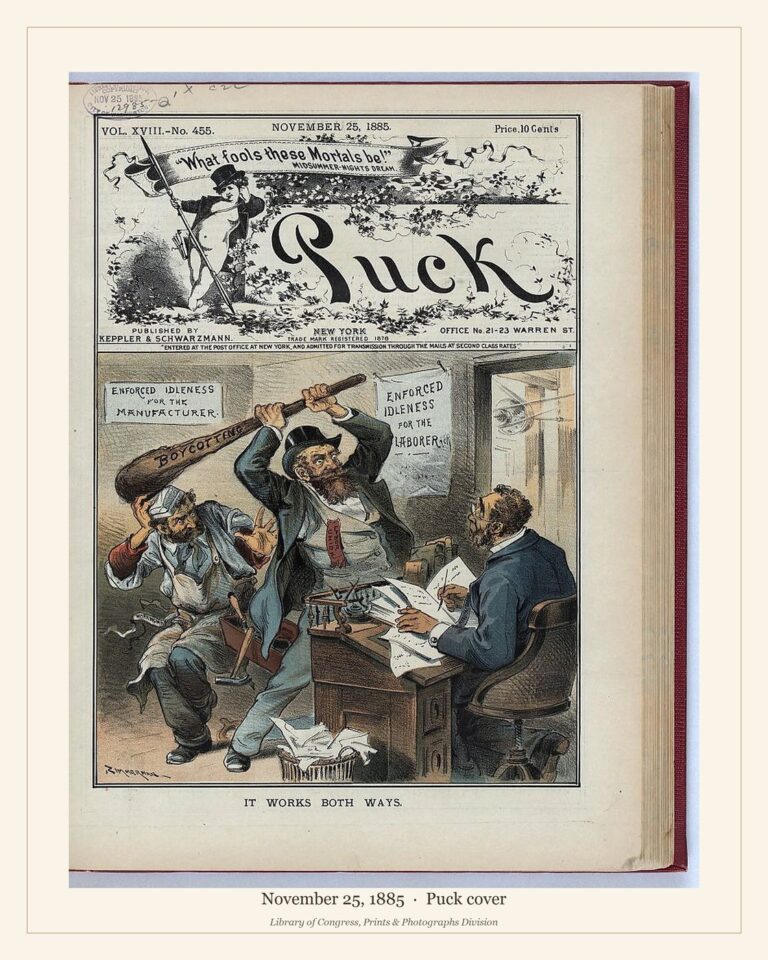
Judge was founded in 1881 by a group of artists led by James Albert Wales, who left Puck to start a competing colour humour weekly. It struggled at first against the established Puck, but Republican political interests, recognising the value of a colour cartoon paper on their side, helped put it on a firm footing. By the mid-1880s Judge had become the Republican counterpart to the Democratic-leaning Puck.
It adopted the same successful formula — a full-page chromolithograph political cartoon on the cover, a colour centrefold inside — and competed directly for the same national readership.
Politics and artists
Where Puck attacked Republicans and the trusts, Judge caricatured Democrats and championed protective tariffs and Republican candidates. Its artists included Grant Hamilton, Bernhard Gillam (who moved over from Puck), and the prolific comic draughtsman Eugene ‘Zim’ Zimmerman. In presidential years the two weeklies functioned as visual campaign organs, their duelling colour cartoons carrying the argument to the public.
This two-sided contest is a large part of why the 1880s and 1890s are remembered as the peak of American cartooning: the colour cartoon had become a genuine, competitive political medium.
Outlasting the rival
In the long run Judge outlasted Puck commercially. As the colour-cartoon weekly declined before the mass magazines, Puck closed in 1918, while Judge continued into the 1930s and formally until 1947, though it shifted toward general humour and lost its political-cartoon centrality. Its great era was the one it shared with Puck.
Judge’s turn-of-the-century covers remain a vivid colour record of American politics as seen from the Republican side — the other half of a conversation that Puck’s covers only half preserve.
Legacy
Together, Puck and Judge established the American political cartoon as a colour art and a public force. Judge’s covers, like Puck’s, are fine chromolithographs and a historical record — and they are essential to understanding the period’s visual politics as an argument with two sides.
The Judge and Puck covers in our archive are restored from Library of Congress scans, each dated to the real issue it appeared on. Browse the Judge covers →
Frequently asked questions
How did Judge begin?
In 1881, when artists led by James Albert Wales left Puck to found a rival colour humour weekly. With Republican backing it became the Republican counterpart to the Democratic Puck.
How was it different from Puck?
Same format, opposite politics: Judge championed Republican candidates and tariffs and caricatured Democrats and reformers.
Did Judge outlast Puck?
Yes — Puck closed in 1918; Judge continued into the 1930s and formally until 1947, though its great political-cartoon era was shared with Puck.
Who drew for Judge?
Grant Hamilton, Bernhard Gillam, and Eugene ‘Zim’ Zimmerman, among others.
Further reading
- Browse Judge covers
- Browse Puck covers
- Frank Luther Mott, A History of American Magazines (Harvard University Press, 1938–1968).
- Richard Samuel West, Satire on Stone: The Political Cartoons of Joseph Keppler (University of Illinois Press, 1988).
The Day Press curates, restores, and reformats public-domain American printed images from 1885 to 1928 for archival-quality home printing. Browse the archive · Browse by theme, month, decade.